Bathroom tile installation on Cape Cod

Bathroom tile installation is the supply, setting, and finishing of ceramic, porcelain, natural stone, or glass tile in wet and dry bathroom areas: floor slabs, shower and tub surrounds, full wet rooms, and accent niches, over a properly prepared and waterproofed substrate.

It is the right call when old tile is cracked, when a shower pan is leaking, when a remodel is changing the layout, or when a substrate has failed underneath the surface. On Cape Cod, humid summers and salt air make moisture management in a bathroom more consequential than inland. A waterproofing membrane and a flood-tested shower pan are not optional details here.

Daniel Araujo holds a Massachusetts Construction Supervisor License (CSL), Unrestricted (#CS-123114), and Forty One Construction is a BBB Accredited Business. We carry 51 Google reviews at 5 stars.

This page covers what a bathroom tile installation includes, what it costs in 2026, how tile materials compare for wet areas, and what the substrate under Cape Cod bathroom tile actually requires to hold up.

Gloved hands pressing white tile onto yellow adhesive wall, a Forty One Construction project on Cape Cod

Massachusetts License

CS-123114

MA CSL · Unrestricted

Home Improvement

217279

MA HIC Registration

Accreditation

BBB

Accredited Business

Google Reviews

5 Stars

51 Google Reviews

Project Planning

Free

On-Site Estimates

Before You Start · Cape Cod

How do I know if my bathroom tile needs to be replaced rather than repaired?

If the substrate beneath the tile has failed or the waterproofing has been breached, replacement is the right answer. Surface cracks or stained grout can sometimes be repaired. A soft floor, hollow-sounding tiles, or active leaks mean the system underneath is gone.

  • Hollow tiles. Tap across the floor or shower wall. A tile that sounds hollow has lost its mortar bond and will crack or lift under foot traffic.
  • Soft or spongy floor. A floor that flexes underfoot near a shower or tub usually means the substrate or subfloor underneath has absorbed water over time.
  • Cracked or missing grout. Open grout joints in a shower allow water behind the tile, where it attacks the substrate and eventually the structure of the floor.
  • Staining that won't clean. Persistent dark staining in grout or at tile edges often means water has been moving behind the surface for longer than it looks.
  • Leaks at the ceiling below. If a bathroom on an upper floor is causing water stains on the ceiling below, the shower pan or floor membrane has already failed.
  • Tile that has lifted or popped. Tiles that have come loose, especially in a shower, mean the bond or the waterproofing layer beneath them is no longer intact.

The one you cannot see matters most. A shower pan with no waterproofing membrane, or a membrane installed without a flood test, can leak for months before the damage shows on the surface. If you do not know what is under your shower floor, it is worth finding out before you regrout.

Tile Installation · Cape Cod

What a bathroom tile installation includes from substrate prep to final walkthrough

A bathroom tile installation with Forty One Construction runs through seven phases, from the first on-site assessment to the final inspection and walkthrough in Hyannis. Each phase has a clear purpose and a point where you review progress before we move forward.
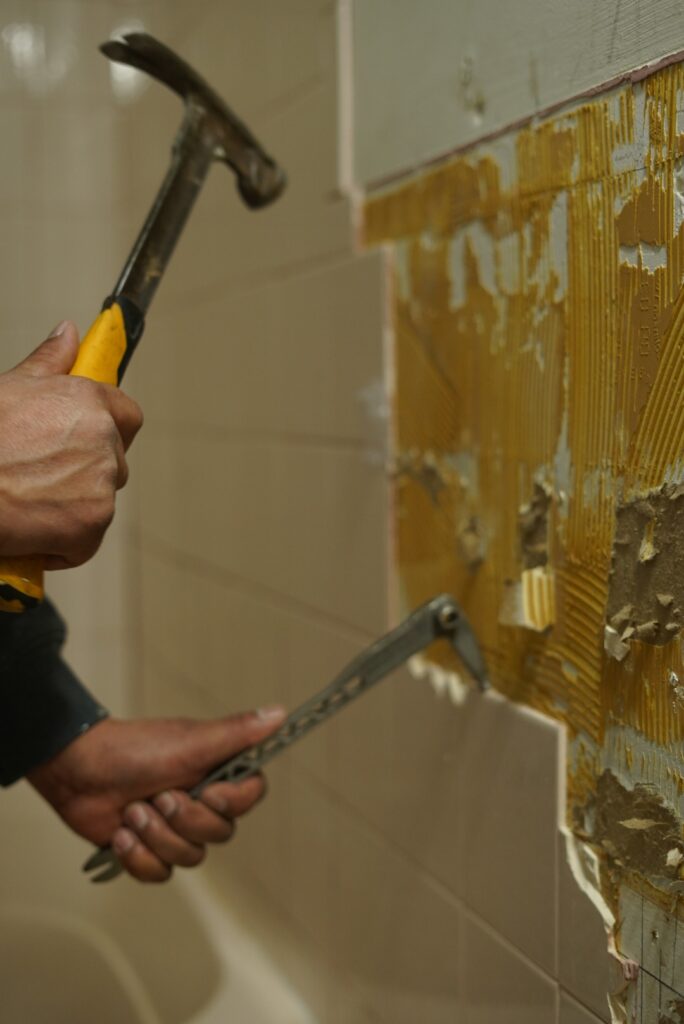
Two hands removing ceramic wall tiles with hammer and chisel, a Forty One Construction project on Cape Cod

Planning · Phase One

Assessing the site and planning the layout before tile is ordered

01

Site assessment and design

We visit the bathroom, inspect the existing substrate for level and moisture problems, measure the space, and talk through your tile choice and pattern. You get a written scope covering materials, prep work, and what is included before anything is ordered or scheduled.

02

Permits and requirements

Tile work in bathrooms may require a building permit depending on the scope of the project and the municipality. Where a permit is needed, we prepare the documentation and submit it to the relevant local authority. The permit is pulled in our name, not yours, because we are the contractor doing the work.

Hands holding hammer and chisel demolishing bathroom wall tiles, a Forty One Construction project on Cape Cod

Preparation · Phase Two

Preparing the substrate and waterproofing before any tile is set

03

Demo and substrate prep

We remove existing tile and flooring where needed and inspect the subfloor underneath. If the subfloor is damaged from water intrusion, we address that before proceeding. Cement backer board or a waterproofing membrane system goes in before the first tile is set.

04

Waterproofing

In shower pans and wet-area walls, a waterproofing membrane is installed to manufacturer specification before any tile goes on. Shower pans are flood-tested to confirm the membrane holds water before we set tile over it. This step is not optional and is not skipped to save a day.

05

Layout and dry-fit

We plan the tile layout on the floor or wall before we set anything permanently. This means marking reference lines, dry-fitting tiles to confirm pattern and cut placement, and identifying where cut tiles fall so the finished room looks balanced from the door.

Two hands prying ceramic wall tiles off adhesive backing, a Forty One Construction project on Cape Cod

Setting · Phase Three

Setting tile, grouting, and completing the finished surface

06

Tile setting and grouting

Thin-set mortar is applied with the correct trowel notch for the tile size, and tiles are set with spacers or a leveling clip system to control lippage and keep grout lines consistent. After the appropriate cure time, grout is applied, cleaned, and sealed. Natural stone gets a separate stone sealer.

07

Final inspection and walkthrough

We inspect the finished surface for lippage, grout consistency, and full coverage, then walk the completed bathroom with you. You look at the work, ask questions, and we do not call it done until you are satisfied with the result.

Scope · What You Are Buying

What your tile installation quote covers, and what it does not

A tile installation quote from Forty One Construction covers substrate prep, backer board or membrane installation, tile handling, cutting and setting, grouting, sealing, and basic debris disposal. The tile material itself, plumbing fixture work, electrical, structural subfloor repairs beyond standard leveling, and permit fees where required are quoted separately rather than assumed into the number.

Included in the quote

  • Site assessment and layout planning
  • Backer board or waterproofing membrane installation
  • Tile cutting, setting, and grouting
  • Sealing grout and natural stone surfaces
  • Basic debris and old tile disposal
  • Shower pan flood test in wet areas
  • Custom mosaic or specialty pattern design fees

Not included, quoted separately

  • Tile and material purchase
  • Plumbing fixture rough-in or relocation
  • Electrical work in the bathroom
  • Structural subfloor repair beyond standard leveling
  • Permit fees where required by the municipality

Done correctly means substrate flatness within 1/8 inch over 10 feet, or 1/16 inch over 24 inches for large-format tile per TCNA and ANSI A108 standards, a waterproofing membrane installed to manufacturer specification with a flood-tested shower pan, slope to drain at 1/4 inch per foot, mortar coverage at 95 percent in wet areas, and grout left to cure 24 to 72 hours before water exposure. These are not preferences. They are what holds a tiled shower together over years of daily use.

Hands holding hammer near partially removed bathroom wall tiles, a Forty One Construction project on Cape Cod

Tile Cost · Cape Cod

How much does bathroom tile installation cost on Cape Cod?

Bathroom tile installation on Cape Cod typically runs $12 to $28 per square foot installed in 2026, with Forty One Construction quoting each job in Hyannis after an on-site visit. Natural stone and mosaic work run above that range depending on material and pattern complexity.

Cost depends on tile material, pattern complexity, substrate condition, and waterproofing scope for the specific bathroom.

$30–$75 Per square foot installed
$10K–$20K Full bathroom floor and shower surround

Cost Factors

What moves the price

The price shifts with a handful of real drivers, including tile material, pattern complexity, substrate condition, waterproofing scope, and demo of old tile.

01

Tile material grade

Ceramic costs least; porcelain, natural stone, and glass mosaic cost progressively more per square foot.

02

Pattern and tile size

Herringbone, hexagon, and mosaic patterns take longer to set than straight-lay large-format tile.

03

Substrate condition and prep

A subfloor that needs leveling or repair, or a shower that needs a full waterproofing membrane system, adds time and material cost.

04

Waterproofing scope

A simple bathroom floor needs less waterproofing than a full wet-room shower pan with a membrane and flood test.

05

Demo and Cape Cod logistics

Removing old tile and seasonal material delivery lead times on the Cape can affect total project cost.

2026 Cost Guide

Typical tile job cost by scope

These ranges are a starting point for planning. Every bathroom tile job is quoted after an on-site assessment.

Job size and scope Typical range on Cape Cod (2026)
Small floor or backsplash (25 to 50 sq ft) Lower end of $12 to $28 per sq ft
Standard bathroom floor plus shower surround Mid-range; ceramic and porcelain stay inside $12 to $28 per sq ft
Full wet room or floor-to-ceiling tile with custom niches Upper end; natural stone and mosaic push above the base range

Material delivery lead times on the Cape and permit timing factor in too. Every job is quoted after an on-site visit.

Get a Free Estimate →

Tile Materials · Cape Cod

Ceramic, porcelain, stone, or glass: which tile holds up in a coastal bathroom?

The right tile depends on where it goes, how much traffic it sees, and what the substrate can support. In a humid coastal climate, the substrate system and waterproofing matter as much as the tile face. Below are the main tile types we install, honestly compared. Whatever the surface, we set tile over a properly prepared substrate so the finish lasts.

Glazed ceramic field tile with shiny smooth surface. Illustrative image.

Ceramic · Entry Tier

Glazed ceramic tile

The most affordable option and widely available in many sizes and finishes. Glazed ceramic is durable in low-traffic areas and easy to cut and set. Best for bathroom floors and accent walls on a tighter budget. In wet areas it needs a properly waterproofed substrate to perform over time.

Large-format porcelain slab showing full through-body veining. Illustrative image.

Porcelain · Workhorse

Porcelain tile

Through-body porcelain is denser and less porous than ceramic, making it well-suited to wet areas and high-traffic bathroom floors. Large-format sizes from 12x24 to 24x48 are common for a clean, low-grout-line look. Best for shower floors, wet rooms, and full bathroom floors where durability matters.

Polished marble tile with natural gray and white veining. Illustrative image.

Natural Stone · Premium

Marble, travertine, and slate

Natural stone brings variation and texture that no manufactured tile replicates. Marble and travertine are common in bathroom applications and take a polished or honed finish. All natural stone is porous and must be sealed before and after grouting. Best for homeowners who want a premium surface and will maintain it with periodic resealing.

Rolled sheet of waterproof membrane for shower substrate. Illustrative image.

Glass and Mosaic · Accent

Glass and mosaic sheet tile

Glass tile and mosaic sheets are typically used for accent walls, niches, and decorative borders rather than full floors. They require a white thin-set to avoid color bleed-through and more precise back-buttering for full coverage. Best for homeowners who want a visual focal point in the shower or bathroom without covering the full room in a single material.

Small mosaic glass tile sheet mounted on mesh backing. Illustrative image.

Substrate Systems

Backer board and membrane

The substrate system behind the tile is what makes a wet-area installation last. Cement backer board, CBU, and membrane systems like Schluter-Kerdi, Wedi, and Laticrete Hydro Ban are the current standard for shower and wet-room applications. The system we use depends on the specific site conditions and what the tile and layout require.

Material Comparison

Compare tile options

Compare where each tile type fits best, how it performs in wet bathroom conditions, and the maintenance level it requires.

Option Best for Wet area performance Maintenance
Glazed ceramic Tight budgets Fair with proper substrate Low
Porcelain Floors and showers Very good, low porosity Very low
Natural stone Premium surfaces Good when sealed Medium (resealing)
Glass and mosaic Accents and niches Good in accent use Low
Large-format porcelain Wet rooms, minimal grout lines Excellent Very low

We name real setting materials when we spec a job, thin-set and grout from Mapei, Laticrete, Custom Building Products, and Ardex, and membrane systems from Schluter, Wedi, and Laticrete. If a simpler material fits the space and budget better, we will say so.

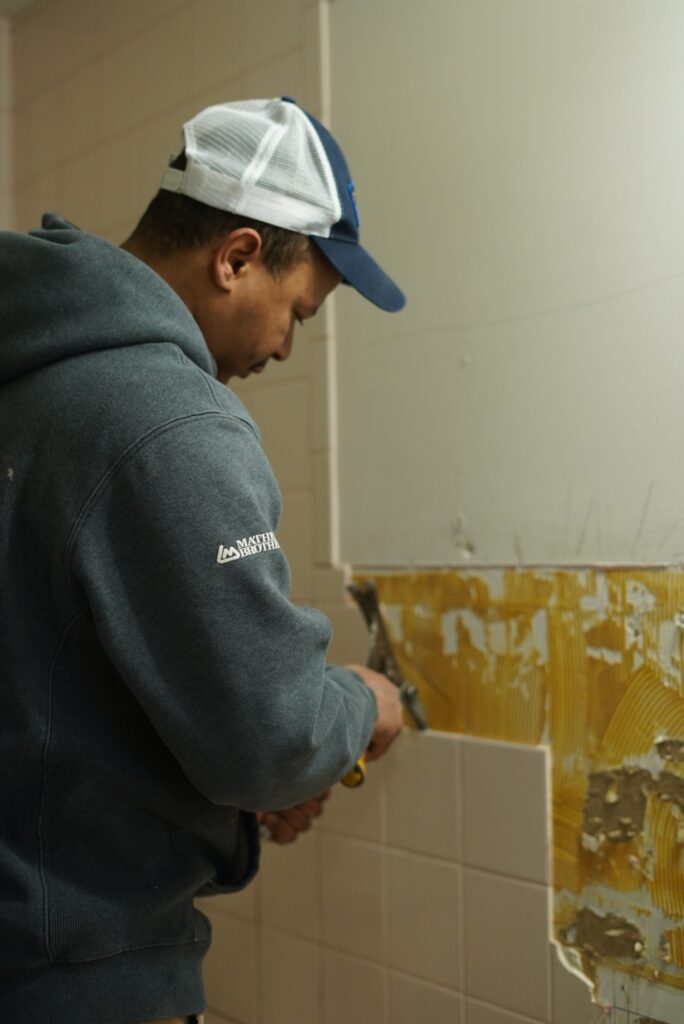
Worker in cap using hammer to remove tiles above bathtub surround, a Forty One Construction project on Cape Cod

Project Timeline · Cape Cod

How long does bathroom tile installation take on Cape Cod?

A bathroom tile installation with Forty One Construction takes anywhere from 1 to 2 days for a small floor or backsplash of 25 to 50 square feet, 3 to 5 days for a standard bathroom floor plus shower surround, and 1 to 2 weeks for a full wet room or floor-to-ceiling tile job with custom niches and pattern work, not counting cure and dry time between waterproofing and tile-setting stages.

Two things stretch that window on the Cape. Waterproofing membranes and shower pan flood tests require cure time before tile can be set over them, and that time is fixed regardless of schedule pressure. Material delivery lead times for specialty tile and setting materials can also run longer here than in a mainland market, especially during the busy summer season when supplier schedules tighten and ferry or ground delivery windows are less predictable.
3–5 days Small floor or backsplash: 25 to 50 sq ft
1–2 weeks Standard bathroom floor plus shower surround
3–5 weeks Full wet room with custom niches and pattern work
Man in cap and hoodie removing bathroom wall tiles, a Forty One Construction project on Cape Cod

Tile Substrate · Cape Cod

What the substrate under a Cape Cod bathroom tile installation actually requires

The substrate is everything under the tile surface: the subfloor, the backer board or membrane, and the mortar bed. It is where a tile installation is made watertight or made to fail. On Cape Cod, two details decide whether bathroom tile holds up: how the substrate handles moisture, and whether the shower pan waterproofing is installed and tested correctly. Get either wrong and the tile cracks, the grout fails, or water reaches the structure.

Flatness and Support

Substrate flatness and subfloor condition

A tile installation is only as good as the surface it sits on. TCNA and ANSI A108 standards require substrate flatness within 1/8 inch over 10 feet, and 1/16 inch over 24 inches for large-format tile. A subfloor that flexes or has soft spots from water damage will cause tiles to crack and grout lines to open up over time. We inspect the subfloor at the start of every project and address any leveling or repair before backer board or membrane goes in. Skipping that step is the most common source of early tile failure.

Waterproofing

Shower pan waterproofing and membrane installation

The waterproofing layer in a shower is what keeps water inside the pan and off the structure of the house. We install membrane systems to manufacturer specification, slope the floor to drain at 1/4 inch per foot, and flood-test every shower pan before setting tile over it. Cape Cod's humid summers mean bathrooms that hold moisture over long seasons, so a membrane installed correctly is not a premium add-on. Grout joints and mortar coverage follow TCNA standards, with 95 percent coverage required in wet areas, and grout is allowed to cure the full recommended time before water exposure. Every structural decision is made to hold up under daily wet use, not just on day one.

Service Life · Coastal Exposure

How long does bathroom tile installation last on Cape Cod?

The substrate and waterproofing decide it, not the tile face. A properly set tile installation over a sound subfloor, a correct membrane, and full mortar coverage will outlast one installed over a failed substrate regardless of how good the tile material is. We do not publish a single lifespan number, because the honest answer depends on the installation, the substrate condition, and the maintenance, and a figure that ignores all three is not useful.

  • Humidity affects grout and stone. Cape Cod's humid summers keep bathrooms wetter for longer stretches than inland homes. Natural stone and porous grout absorb moisture over time if not sealed and maintained, which is why sealing is part of the installation and not an afterthought.
  • Failed waterproofing is invisible until it is not. A shower pan without a properly flood-tested membrane can leak behind tile for a long time before water shows up on the ceiling below or the subfloor gives way underfoot.
  • Grout that is not sealed fails sooner. Open or unsealed grout joints in a shower allow water to work behind the tile face, which attacks the substrate and eventually the subfloor and framing underneath.
  • Maintenance that extends the life. Reseal natural stone and grout on a schedule, replace any cracked or hollow tile before water gets behind it, and check caulk at the tub-to-tile joint and tile-to-fixture transitions where movement tends to open gaps first.

Forty One Construction backs labor and installation with a 5-year workmanship warranty. Manufacturer warranties on tile and setting materials are provided separately by the manufacturer and vary by product.

Local Tile Installer · Cape Cod

Where we install bathroom tile across Cape Cod and the South Shore

Forty One Construction installs bathroom tile across Cape Cod from our office in Hyannis, and local conditions shape every job. Humid summers keep bathrooms wetter for longer periods than inland, material delivery lead times for specialty tile can run longer here, and a summer project calendar that fills up well before Memorial Day means scheduling matters as much as budget when you are planning a bathroom tile project on the Cape.

We serve homeowners from the outer Cape through the canal, including Provincetown, Truro, Wellfleet, Eastham, Orleans, Chatham, Brewster, Harwich, Dennis, and Yarmouth on one side, and Hyannis, Centerville, Osterville, Cotuit, Mashpee, Falmouth, Bourne, Sagamore, Sandwich, and Barnstable through the mid- and upper Cape, along with Plymouth on the South Shore.

Hyannis Home Base
Cape Cod Local Coverage
Plymouth South Shore
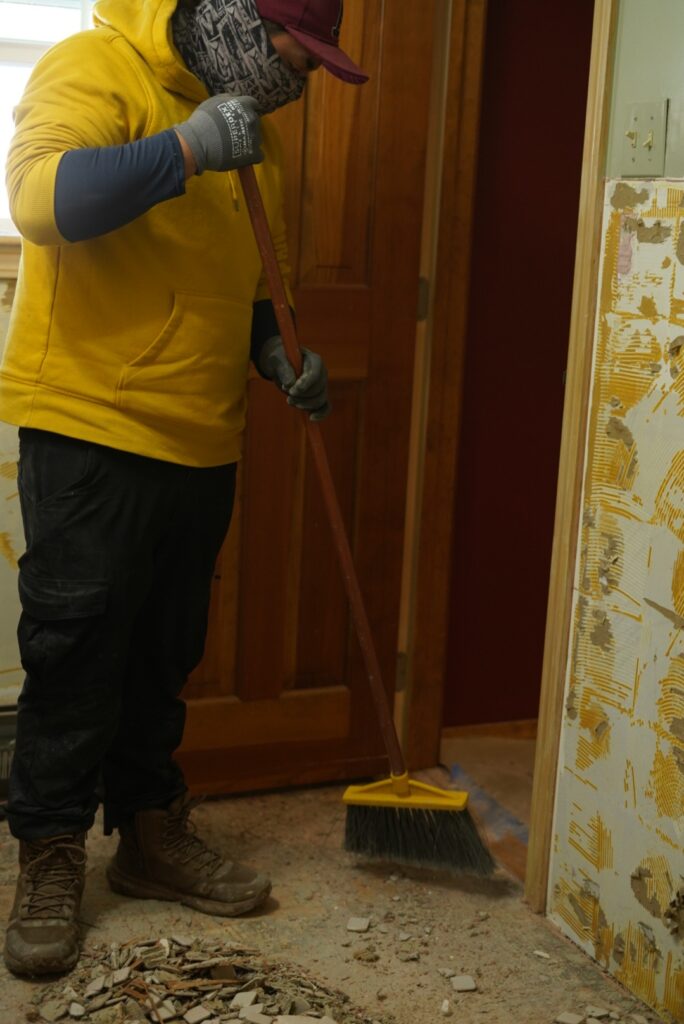
Worker sweeping demolished tile debris off concrete subfloor, a Forty One Construction project on Cape Cod

Credentials · Accountability

What to verify before your project starts

Credentials

License and coverage you can verify

Daniel Araujo holds a Massachusetts Construction Supervisor License (CSL), Unrestricted (#CS-123114), and the company holds Home Improvement Contractor registration #217279. We carry $1,000,000/$2,000,000 general liability coverage, and a certificate of insurance is available on request. The numbers are printed so you can check them. Learn more about us.

Permits · Code

We pull the permit and build to code

We submit drawings to the Town of Barnstable Building Division and pull the permit in our name. Footings reach frost depth, ledgers get through-bolted and flashed, and every connection is built to pass framing and final inspection, not just to look finished.

Before Construction

A written scope before we order a board

You get a written scope up front, so the number in your hand is tied to specific materials and work, not a vague figure that grows halfway through. When quotes look interchangeable on paper, that's usually where the real difference sits.

Worker sweeping broken tile debris off concrete subfloor, a Forty One Construction project on Cape Cod

Client Testimonials

Real clients. Their own words.

Hear directly from our clients about their experience working with Forty One Construction. Select a video to watch their story.

Forty One Construction · Client Stories Click to play · Sound on

Homeowner Reviews

What homeowners in Hyannis say

Forty One Construction holds a 5-star rating across 51 Google reviews.

5.0 ★★★★★ Google Reviews
★★★★★ Google
“From the first walkthrough to the final cleanup, their professionalism stood out. They explained every step clearly, offered smart recommendations…”
Brian Timmins Google review excerpt Google
★★★★★ Google
“We are enjoying our deck and patio and we love the fresh look our house now has.…”
Stephanie York Google review excerpt Google
★★★★★ Google
“Outstanding communication, craftsmanship, customer care and pricing. I would recommend them for any home improvement project, large or small.…”
RedBalloon Google review excerpt Google

Custom Decks · Cape Cod

Questions about bathroom tile installation on Cape Cod

Do you require a deposit, and how are payments structured for a tile job?

Massachusetts consumer guidance advises homeowners not to pay more than one-third of the estimated cost upfront unless special-order materials are involved. We work within that standard and tie payments to a written scope. Specialty tile ordered for a specific project may affect the payment structure, and we will explain that clearly before you sign anything.

Which tile and setting material brands do you work with?

We set ceramic, porcelain, natural stone, and glass and mosaic tile depending on the application. For setting materials we work with Mapei, Laticrete, Custom Building Products, and Ardex. Membrane and substrate systems include Schluter-Kerdi, Wedi, and Laticrete Hydro Ban. We spec the system to the specific bathroom and the tile being installed, not to a single preferred product.

Will a bathroom tile installation disrupt the rest of my home during the project?

Tile work is contained to the bathroom being worked on. The main disruption is losing access to that bathroom for the duration of the project, including cure time between waterproofing and tile-setting stages. If the bathroom is the only one in the home, we will plan the schedule with that in mind and tell you upfront how long you will need alternate arrangements.

What should I do to prepare the bathroom before your crew arrives?

Clear personal items, towels, and any stored goods from the bathroom and the area directly outside it. If there is existing tile being removed, take down wall mirrors and fixtures you want to keep. We handle demo, substrate prep, waterproofing, and cleanup. If we need anything specific from you before we start, we will let you know at the site assessment.

What if there is a problem with the tile installation after you finish?

Every installation carries a 5-year workmanship warranty on labor and installation. Manufacturer warranties on tile and setting materials are provided separately by the manufacturer. If something is not right with our work, contact us and we will come out and look at it. If the issue is our error, we address it at no cost to you.

Another contractor quoted less for the same bathroom tile job. What accounts for the difference?

The gap usually sits in what is not written down: whether the substrate gets properly leveled, whether a waterproofing membrane is flood-tested before tile is set over it, whether the correct trowel notch is used for the tile size, and whether the grout is allowed full cure time before water exposure. We are a licensed local contractor who pulls permits where required and stands behind the work with a written warranty on labor and installation.

Do I need a permit for bathroom tile installation in Hyannis?

Permit requirements for bathroom tile depend on the scope of the work and the specific municipality. A straightforward tile replacement may not require one, but a project that involves altering the shower pan, moving plumbing, or significant structural subfloor repair may. We review what is required for your specific job at the assessment stage and handle any permit submissions in our name where one is needed.

When is the best time of year to schedule bathroom tile installation on Cape Cod?

Bathroom tile is interior work, so it is not constrained by freeze-thaw or exterior weather the way roofing or siding is. That said, the summer season on the Cape is the hardest window to book. Demand from seasonal homeowners runs high from Memorial Day through Labor Day, and material delivery lead times for specialty tile can stretch during that period. Scheduling in the shoulder seasons, spring or fall, typically gives more flexibility on start dates and crew availability.

Free On-Site Estimate

Get a Quote

Ready to talk through your project? Forty One Construction will come out, look at your yard, and give you a written scope tied to real materials and a real number. Every install carries a 5-year workmanship warranty on labor and installation, with manufacturer warranties on materials provided separately by the manufacturer.

Our crew builds across Hyannis and Cape Cod, and our office is at 76 W Main St Unit 306, Hyannis, MA 02601. Call us or request an estimate and we'll get you on the calendar honestly, weather and permits accounted for.

Free Estimate
Owner-Led Service
Serving Cape Cod

No-pressure consultation · Clear upfront pricing