Exterior carpentry on Cape Cod

Exterior carpentry covers the repair, replacement, and installation of the wood and wood-alternative components that make up the outside of your house: fascia, soffit, rake boards, corner boards, siding, casings, sills, and trim, along with the flashing and fastening details that keep water out.

It is the right call when rot has worked into a fascia board, when wind-driven rain has gotten behind a window casing, or when cedar shingles have failed at the corners. On Cape Cod the details decide how long it lasts: airborne salt corrodes the wrong fasteners fast, freeze-thaw splits unsealed cut ends every winter, and sideways rain off the water finds every gap that was not properly flashed or caulked.

Daniel Araujo holds a Massachusetts Construction Supervisor License (CSL), Unrestricted (#CS-123114), and Forty One Construction is a BBB Accredited Business. We carry 51 Google reviews at 5 stars.

This page covers what exterior carpentry includes, what it costs in 2026, how lumber and trim materials compare in a coastal climate, and what the flashing and fastening details on a Cape Cod house actually require.

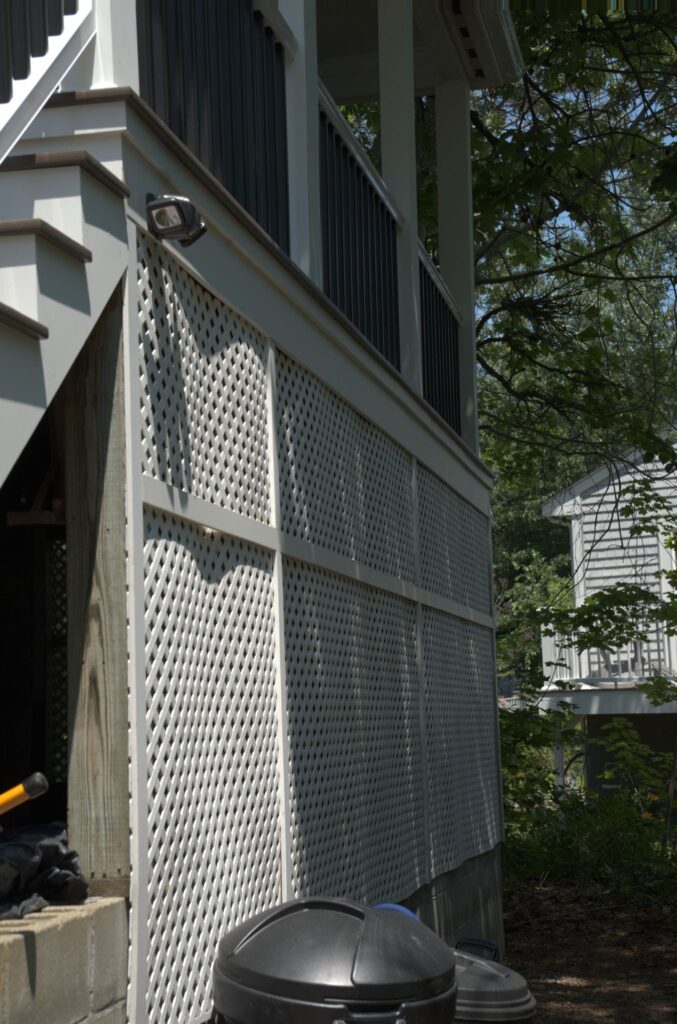
Under-porch lattice skirting panels below elevated deck with dark balusters, a Forty One Construction project on Cape Cod

Massachusetts License

CS-123114

MA CSL · Unrestricted

Home Improvement

217279

MA HIC Registration

Accreditation

BBB

Accredited Business

Google Reviews

5 Stars

51 Google Reviews

Project Planning

Free

On-Site Estimates

Before You Start · Cape Cod

How do I know if my exterior trim or siding needs to be replaced rather than painted over?

If the wood is soft, painting over it delays the problem rather than solving it. Surface wear is worth repainting. Rot or water damage behind the surface is not, because the money goes into material that is already failing.

  • Soft or spongy wood. Press a screwdriver into a fascia board or corner board. If it sinks without much force, rot is present and paint will not stop it from spreading.
  • Rust streaks on siding. Dark lines bleeding down from nail heads or trim fasteners mean corroding hardware. Salt air does that to anything that is not stainless or hot-dip galvanized.
  • Gaps at window or door casings. If the caulk joint has opened or the paint is bubbling at the edge, water is already working behind the casing and into the wall.
  • Staining on interior walls near windows. Water that has gotten past a casing or sill often shows up on the inside before it is obvious outside.
  • Paint that fails in the same spot every cycle. Exterior paint that peels repeatedly in one area usually means moisture is coming from behind, not just weathering on the surface.
  • Trim that has pulled away from the wall. A gap between trim and sheathing lets wind-driven rain in at the wall, which is exactly where the damage starts on Cape Cod.

The one you cannot see matters most. Rot behind a rake board or soffit can work back into the roof sheathing or rafter tails before it shows on the surface. A soft spot you can probe from outside may mean a much larger repair once the material comes off. Find out what is behind it before deciding to paint or caulk over it.

Exterior Carpentry · Cape Cod

What exterior carpentry with Forty One Construction includes from inspection to final walkthrough

An exterior carpentry project with Forty One Construction runs through seven phases, from the first on-site inspection to the final walkthrough in Hyannis. Every phase has a clear purpose, and you see the scope and materials before anything is ordered or removed. Here is what each phase covers.
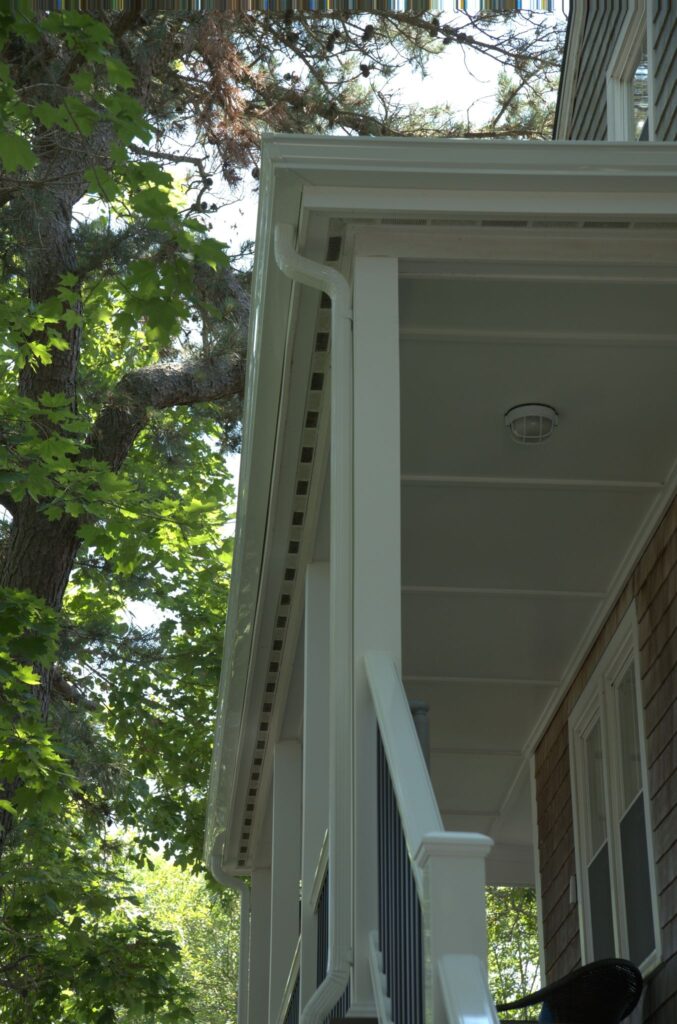
White porch soffit with vented eave, gutter, and light fixture, a Forty One Construction project on Cape Cod

Assessment · Phase One

Assessing the damage before any material is ordered

01

Inspection and rot assessment

We come to your home, probe suspect wood, and check the flashing, housewrap, and caulk at every transition. You get a written scope that says exactly what is rotted, what is sound, and what the repair requires before anything is touched.

02

Scope and material selection

We write up the scope and walk you through material options, PT pine, cedar, cellular PVC trim, or composite, matched to the location and your budget. Where a permit is required by the Town of Barnstable Building Division under 780 CMR, we prepare and submit the drawings in our name, not yours.
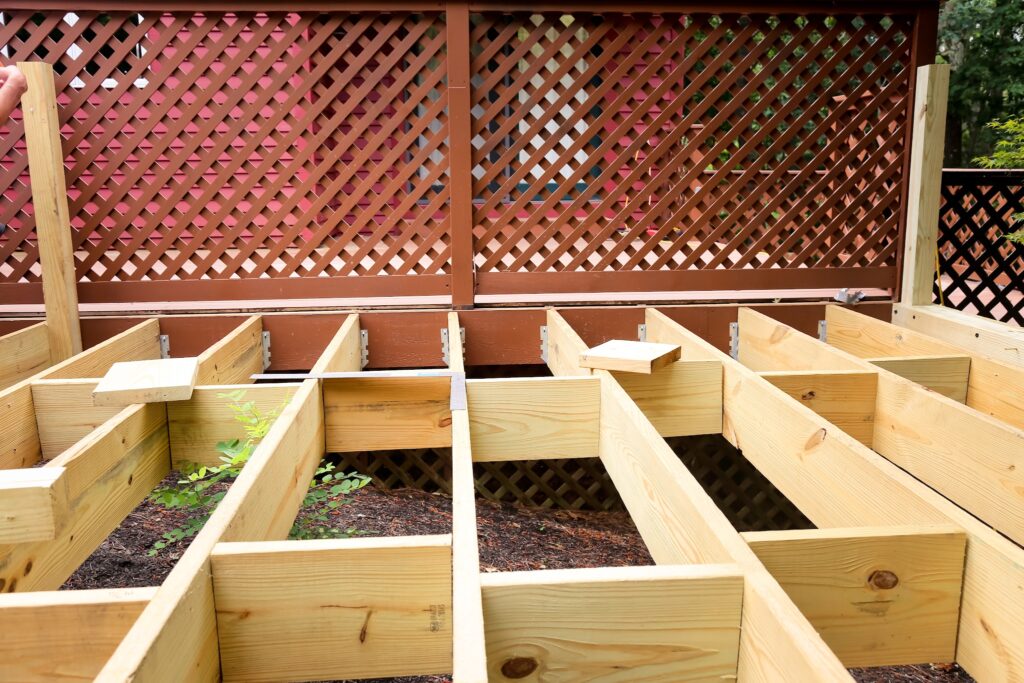
Raised garden beds built from cedar lumber in backyard, a Forty One Construction project in Cotuit, MA

Removal · Phase Two

Removing damaged material and correcting what is underneath

03

Demolition and haul-away

The crew removes rotted or damaged trim, siding, or fascia back to sound wood. We do not cut to the edge of rot and leave questionable material behind. Everything removed is hauled off the site before new material goes on.

04

Flashing and moisture barrier

Before new trim or siding goes on, we check and correct the flashing and housewrap underneath. On Cape Cod, wind-driven rain arrives sideways and gets in at the details, not the middle of the wall. Self-adhered flashing membrane is lapped shingle-style over the housewrap so water that gets past the surface has a path out, not a path in.

05

Fastening and installation

New lumber or trim goes on with corrosion-resistant fasteners. Stainless or hot-dip galvanized only, because galvanized nails bleed rust down new cedar within a season or two in salt air. Cut ends and fastener holes are back-primed before installation, not after, which is where most shortcuts happen.
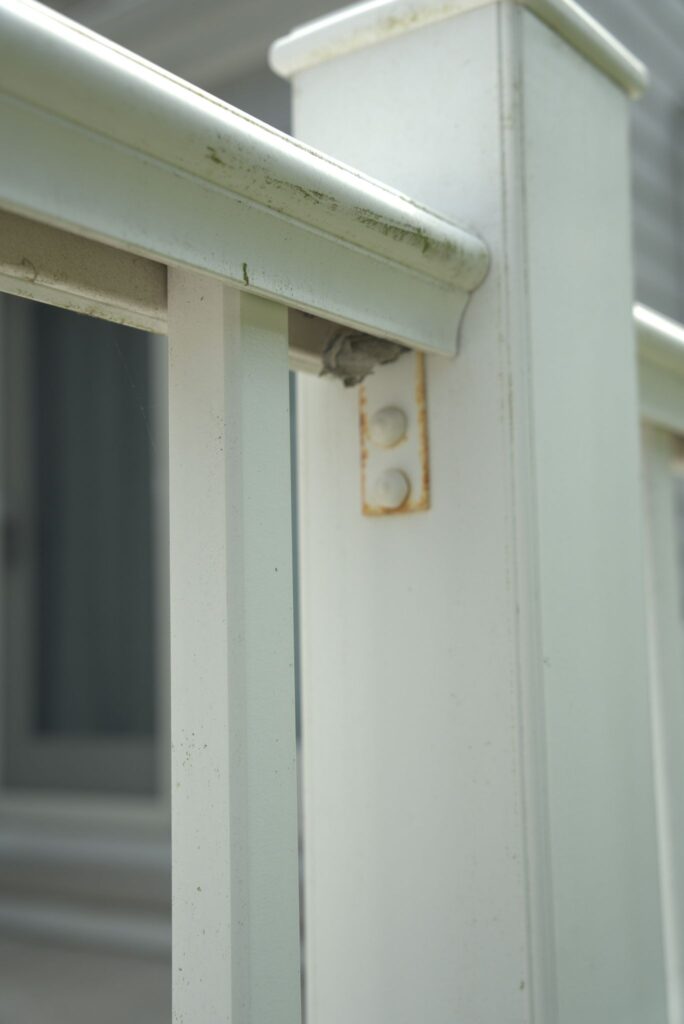
White painted porch column with old door hinge hardware attached, a Forty One Construction project on Cape Cod

Finish · Phase Three

Caulking, priming, painting, and final walkthrough

06

Caulking and priming

All joints and gaps are caulked with a paintable exterior sealant rated for movement. New wood trim gets primer plus a minimum of two finish coats. PVC and composite trim is caulked at transitions but does not need painting unless you want color matched to the house.

07

Final walkthrough and cleanup

We clean the site, haul off any remaining debris, and walk the finished work with you. You can see every joint, every caulk line, and every fastener location. We do not call it done until you agree it is.

Scope · What You Are Buying

What your exterior carpentry quote covers, and what it does not

An exterior carpentry quote from Forty One Construction covers demolition and haul-away of rotted material, flashing and moisture-barrier correction, new lumber or trim, corrosion-resistant fasteners, caulking, and priming of new wood. Full exterior repainting of the whole house, structural framing beyond the carpentry scope, permit fees, and mold or pest remediation are quoted separately rather than assumed into the number.

Included in the quote

  • Demolition and haul-away of rotted material
  • Flashing and housewrap correction at each repair location
  • New lumber, trim material, and corrosion-resistant fasteners
  • Caulking all joints and transitions
  • Back-priming of all new wood and cut ends
  • Primer and minimum two finish coats on wood trim
  • Site cleanup and final walkthrough

Not included, quoted separately

  • Full exterior repaint of the whole house
  • Structural framing repair beyond carpentry scope
  • Permit fees (where a permit is required)
  • Mold or pest remediation unless specified in the estimate
  • Full interior finish work unless specified

Done correctly means all rotted material removed back to sound wood, cut ends and fastener holes back-primed before installation, self-adhered flashing membrane lapped shingle-style over housewrap, stainless or hot-dip galvanized fasteners throughout, moisture content of replacement lumber at or below 19 percent before priming, and all joints caulked with a paintable exterior sealant rated for movement. Those are not preferences. They are what a coastal exterior needs to hold up past the first few winters.

White post base with rust staining at deck surface connection, a Forty One Construction project on Cape Cod

Carpentry Cost · Cape Cod

How much does exterior carpentry cost on Cape Cod?

Exterior carpentry on Cape Cod typically runs between $65 and $125 per hour for labor, or roughly $1,400 to $7,800 per project in 2026, with most jobs landing in the $2,000 to $4,900 range. Forty One Construction quotes each job after an on-site visit. Scope, materials, and accessibility move the number in both directions.

Many exterior carpentry projects fall within our typical range of $2,000 to $4,900.

$30–$75 Labor rate per hour
$10K–$20K Typical project range

Cost Factors

What moves the price

The price moves with a handful of real drivers, including the extent of rot damage, material grade, roof or wall height, linear footage, and seasonal demand.

01

Extent and location of rot or water damage

More rotted material means more removal, more flashing correction, and more new lumber or trim.

02

Lumber and trim material grade

PT pine costs least. Cedar costs more. Cellular PVC or composite trim costs more than either, but needs less maintenance over time.

03

Roof and wall accessibility

Fascia and rake board work at height needs ladders, scaffolding, or a lift, which adds time and cost compared to ground-level trim.

04

Linear footage and number of corners or penetrations

More linear feet of trim, more outside corners, and more window or door penetrations each add material and labor time.

05

Permit requirements and seasonal demand

Structural or egress work may require a permit, adding lead time. Cape Cod's spring and summer remodeling rush also affects scheduling and pricing.

2026 Cost Guide

Typical exterior carpentry cost by scope

These ranges are a starting point for planning. Every job is quoted after an on-site assessment.

Job size / scope Typical range on Cape Cod (2026)
Single fascia or soffit board repair Lower end of $1,400 to $7,800 range
Window or door casing and sill replacement, one or two openings Often a single-day job in the $2,000 to $4,900 range
Full fascia and soffit run or rake board replacement on one elevation Mid to upper range depending on height and material

Permit requirements and inspection lead time factor in too. Every job is quoted after an on-site assessment.

Get a Free Estimate →

Trim Materials · Cape Cod

PT pine, cedar, or PVC trim: which material holds up in a coastal climate?

The right trim material depends on your budget and how much maintenance you want to do, but within a mile or two of salt water, and on Cape Cod most of us are, the fasteners matter as much as the boards. Below are the main options we work with, honestly compared. Whatever the material, we use stainless or hot-dip galvanized fasteners so nothing bleeds rust down your new trim.

Primed finger-jointed pine board showing painted surface and visible finger joints at cut end. Illustrative image.

Trim Wood · Entry Tier

Primed finger-jointed pine

The lowest-cost option and widely used for painted exterior trim. It arrives pre-primed and takes paint well, but it is real wood and will move with moisture if end grain is left unsealed. In salt air and freeze-thaw conditions, we seal every cut end before it goes on the wall.

Cedar shingle with rough-sawn face and tapered edge held to show grain. Illustrative image.

Natural Wood · Coastal Classic

Cedar

Red or white cedar is naturally rot-resistant and a regional standard on Cape Cod. It weathers to a soft gray if left alone or holds color with paint or stain. Best for homeowners who want a natural wood surface. Galvanized nails will stain it, so we fasten cedar with stainless only.

Cellular PVC trim board with smooth white face and clean square cut end visible. Illustrative image.

PVC Trim · Low Maintenance

Cellular PVC trim

All plastic, no wood fiber. It will not rot, does not absorb moisture, and handles salt air better than wood. Best for homeowners who want a trim material that needs no sealing and holds paint well. It costs more up front than pine but requires less maintenance over time in a coastal exposure.

Composite trim board with wood-grain embossed surface and cut end showing solid core. Illustrative image.

Composite · Mid-Range

Composite trim boards

A wood-fiber core wrapped in a polymer shell. More rot-resistant than pine and more dimensionally stable in humid conditions than solid wood. Best for homeowners who want a wood-look surface with less maintenance. Caulk the joints and it performs well in the salt air and humidity of a Cape Cod summer.
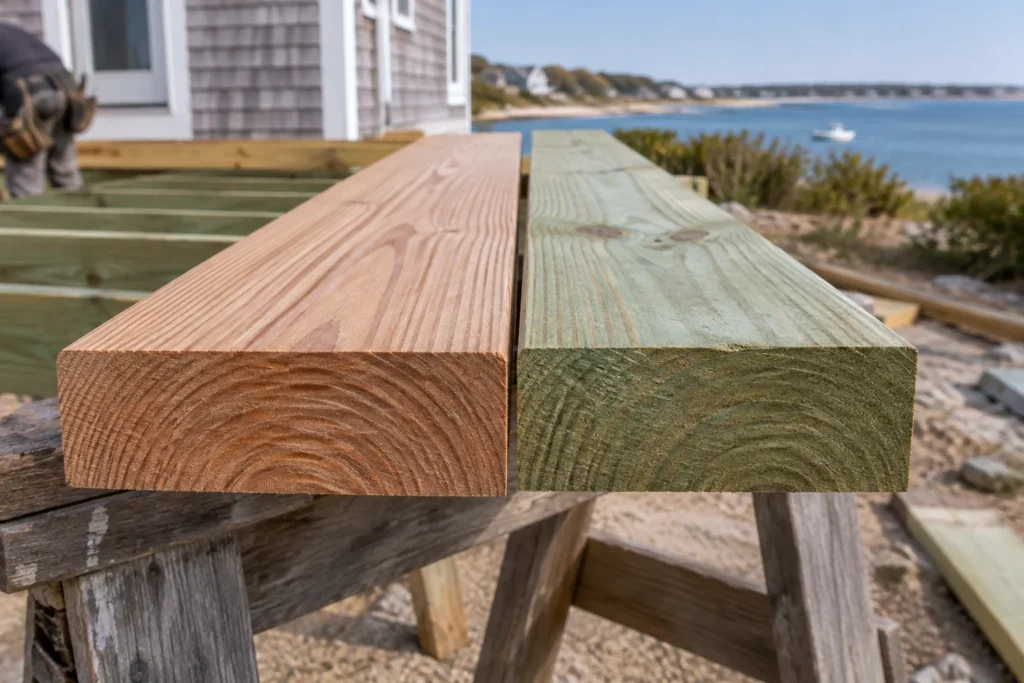
Douglas fir and pressure-treated lumber side by side showing grain and green tint. Illustrative image.

Structural Wood · Framing

Douglas fir and PT lumber

Used where the material carries a load or sits close to grade. Pressure-treated pine handles ground contact and moisture exposure. Douglas fir is used in structural framing where strength and dimensional consistency matter. Both get stainless or hot-dip galvanized fasteners in coastal exposure.

Material Comparison

Compare exterior trim options

Compare where each material fits best, how it performs in Cape Cod salt air, and the level of maintenance it requires.

Option Best for Holds up to salt air Maintenance
Primed pine Tight budgets Fair (seal cut ends) High
Cedar Natural look Good with stainless fasteners Medium
Cellular PVC Zero-maintenance trim Excellent Very low
Composite trim Low-maintenance wood look Very good Low
PT lumber Structural and ground-contact Good Medium

We name real brands when we spec a job, cellular PVC from makers like AZEK, Versatex, Boral, or Trim-Tex, and composite boards where the application calls for it. Structural connectors are Simpson Strong-Tie. If a lower-cost material is the right call for your project, we will tell you rather than spec up unnecessarily.
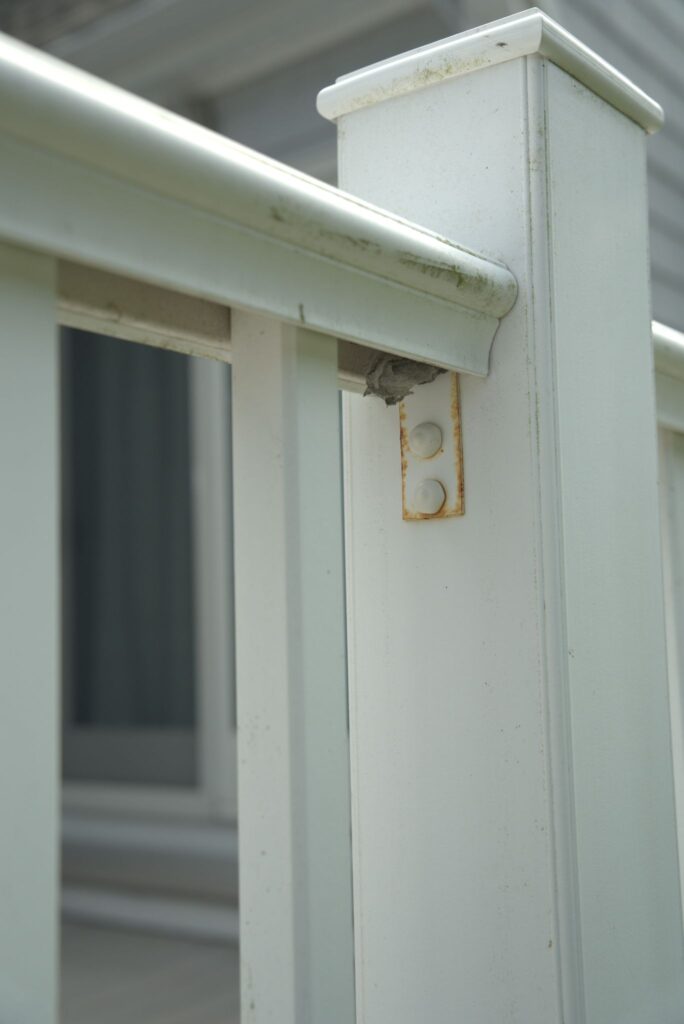
White painted post corner with brass electrical outlet box, a Forty One Construction project on Cape Cod

Project Timeline · Cape Cod

How long does exterior carpentry take on Cape Cod?

An exterior carpentry project with Forty One Construction ranges from a single day for a small trim or fascia repair, to two or three days for a full fascia and soffit run or rake board replacement on one elevation, to one to three weeks for whole-house trim and siding work depending on scope and weather. Permit lead time adds to the front end where a permit is required.

Three things stretch that window here. Permit review at the Town of Barnstable Building Division adds lead time before work begins on structural or egress elements. Freeze-thaw from roughly November through March rules out work that depends on cure or dry time outdoors. And summer traffic on Route 28 and Route 6 between Memorial Day and Labor Day affects crew arrival and material delivery, which we build into an honest schedule rather than promising a date we cannot hold.

3–5 days Small repair · Single board or casing
1–2 weeks Mid-scope · Fascia, soffit, or rake run
3–5 weeks Full scope · Whole-house trim or siding
Under-porch lattice skirting panels below elevated deck with dark balusters, a Forty One Construction project on Cape Cod

Flashing Details · Cape Cod

What flashing and fastening details on a Cape Cod exterior actually require

Flashing and fastening are everything you do not see once the trim is on, and they are where an exterior carpentry job either holds up or fails within a few winters. On Cape Cod, two details decide whether the work lasts: how the flashing is lapped at every transition, and what the fasteners are made of. Get either wrong and rot, rust, or water infiltration follows.

Flashing

Lapping and moisture barriers

A self-adhered flashing membrane lapped shingle-style over the housewrap is not optional in a coastal climate. Wind-driven rain here does not fall straight down. It arrives sideways and gets in at the details, at window corners, at the top of door casings, at the junction of rake boards and roof edges. Every transition gets flashing that directs water out and down rather than in behind the trim. Rushing or skipping this step is the most common invisible shortcut in Cape Cod exterior work, and it shows up as rot behind trim that looks fine from the street.

Fasteners

Corrosion-resistant fasteners in salt air

The entire Cape Cod service area sits within a few miles of salt water. Airborne salt accelerates corrosion on fasteners, hardware, and any unprotected metal. Galvanized nails bleed rust down new cedar within a season or two. Stainless does not. We use stainless or hot-dip galvanized fasteners on every exterior carpentry job, and every cut end and fastener hole is back-primed before the board goes on the wall. Those two details separate work that still looks right in year three from work that does not.

Service Life · Coastal Exposure

How long does exterior carpentry last on Cape Cod?

The flashing and fastening decide it, not the paint. Trim installed with proper flashing, sealed end grain, and stainless fasteners will outlast the same material installed with shortcuts. We do not publish a single lifespan figure, because the honest answer depends on the material, the exposure, and the maintenance, and a number that ignores all three is not useful information.

  • Salt air attacks fasteners first. The whole service area sits within a few miles of salt water. Galvanized nails bleed rust stains down new siding within a season or two. Stainless does not, which is why we specify it on every coastal job.
  • Freeze-thaw finds unsealed cut ends. Water that gets into an open joint or an unsealed end grain freezes, expands, and splits the wood from November through March. Back-priming every cut end before installation is the step that prevents it.
  • Wind-driven rain finds bad flashing. On Cape Cod, rain arrives sideways. Water gets behind siding and trim at the details, not the middle of the wall. Correct flashing laps at every transition are not optional in this climate.
  • Maintenance that extends the work. Keep caulk joints intact, repaint on schedule before bare wood is exposed, and have flashing inspected at trim transitions rather than waiting for an interior stain to appear.

Forty One Construction backs labor and installation with a 5-year workmanship warranty. Manufacturer warranties on materials are provided separately by the manufacturer and vary by product.

Local Carpenter · Cape Cod

Where we do exterior carpentry across Cape Cod and the South Shore

Forty One Construction does exterior carpentry across Cape Cod from our office in Hyannis, and the coastal conditions shape every job. Salt air corrodes the wrong fasteners within a season or two, sideways rain off the water gets in at every flashing detail that was cut short, and freeze-thaw from November through March splits any end grain that was not sealed before winter. Exterior carpentry built for inland Massachusetts is not built for this environment.

We serve homeowners from the outer Cape through the canal, Provincetown, Truro, Wellfleet, Eastham, Orleans, Chatham, Brewster, Harwich, Dennis, and Yarmouth on one side, and Hyannis, Centerville, Osterville, Cotuit, Mashpee, Falmouth, Bourne, Sagamore, Sandwich, and Barnstable through the mid- and upper Cape, along with Plymouth. See our work in Hyannis and Barnstable.

Hyannis Home Base
Cape Cod Local Coverage
Plymouth South Shore
White porch soffit with vented eave, gutter, and light fixture, a Forty One Construction project on Cape Cod

Credentials · Accountability

What to verify before your project starts

Credentials

License and coverage you can verify

Daniel Araujo holds a Massachusetts Construction Supervisor License (CSL), Unrestricted (#CS-123114), and the company holds Home Improvement Contractor registration #217279. We carry $1,000,000/$2,000,000 general liability coverage, and a certificate of insurance is available on request. The numbers are printed so you can check them. Learn more about us.

Permits · Code

We pull the permit and build to code

We submit drawings to the Town of Barnstable Building Division and pull the permit in our name. Footings reach frost depth, ledgers get through-bolted and flashed, and every connection is built to pass framing and final inspection, not just to look finished.

Before Construction

A written scope before we order a board

You get a written scope up front, so the number in your hand is tied to specific materials and work, not a vague figure that grows halfway through. When quotes look interchangeable on paper, that's usually where the real difference sits.

Raised garden beds built from cedar lumber in backyard, a Forty One Construction project in Cotuit, MA

Client Testimonials

Real clients. Their own words.

Hear directly from our clients about their experience working with Forty One Construction. Select a video to watch their story.

Forty One Construction · Client Stories Click to play · Sound on

Homeowner Reviews

What homeowners in Hyannis say

Forty One Construction holds a 5-star rating across 51 Google reviews.

5.0 ★★★★★ Google Reviews
★★★★★ Google
“From the first walkthrough to the final cleanup, their professionalism stood out. They explained every step clearly, offered smart recommendations…”
Brian Timmins Google review excerpt Google
★★★★★ Google
“We are enjoying our deck and patio and we love the fresh look our house now has.…”
Stephanie York Google review excerpt Google
★★★★★ Google
“Outstanding communication, craftsmanship, customer care and pricing. I would recommend them for any home improvement project, large or small.…”
RedBalloon Google review excerpt Google

Custom Decks · Cape Cod

Questions about exterior carpentry on Cape Cod

Do you take a deposit, and when are the remaining payments due for carpentry work?

Massachusetts consumer guidance caps upfront deposits at one-third of the project cost unless special-order lumber or trim materials require prepayment. We tie payment milestones to a written scope that identifies exactly which boards, flashings, and trim runs are covered, so you know what triggers each payment before work begins.

What trim and siding materials do you install?

We work with primed finger-jointed pine, cedar shingles and clapboards, cellular PVC trim from makers such as AZEK, Versatex, Boral, and Trim-Tex, fiber cement, and Douglas fir or PT lumber for structural applications. We spec the material to the exposure, the maintenance expectations, and the budget.

Where does the crew park, and will ladders or scaffolding block my driveway or yard?

Exterior carpentry staging stays outside, leaving interior routines undisturbed. The crew parks on site or at the curb and positions ladders, scaffolding, or a lift in the smallest practical footprint. We identify staging placement during the initial inspection and confirm it with you before material deliveries arrive.

What should I move or clear before the crew starts replacing fascia, soffits, or siding?

Clear the perimeter of the work elevation before the first morning. Move planters, outdoor furniture, grills, and stored items at least six feet from the foundation so ladders seat safely and falling debris does not damage your belongings. We handle everything else, including material staging, probing, and haul-away of rotted trim.

What if something is wrong with the work after the project is done?

Every install carries a 5-year workmanship warranty on labor and installation. Manufacturer warranties on materials are provided separately by the manufacturer. If something is not right with our work, call us, we come out and look at it at no charge, and if it is our error, we fix it at no cost to you.

Another contractor bid this exterior carpentry job lower, so what explains your higher estimate?

Price gaps in exterior carpentry bids usually hide in materials and flashing details. Stainless fasteners, self-adhered flashing membrane at every penetration, back-primed end grain, and a fully itemized scope cost more than galvanized nails and bare cut ends. We pull the permit in our name and carry the workmanship warranty on everything written into the scope.

Do I need a permit for exterior carpentry work in Hyannis?

It depends on the scope. Trim and siding repair that does not affect structural or egress elements typically does not require a permit. Work that involves structural members or egress components is governed by the Town of Barnstable Building Division under 780 CMR. When a permit is needed, we prepare the drawings, submit the application, and pull it in our name.

When is the best time of year to schedule exterior carpentry on Cape Cod?

The exterior season runs roughly April through November. Freeze-thaw from November through March rules out work that depends on paint cure or caulk adhesion, and summer is the hardest time to get on the schedule because demand peaks with the seasonal population. Shoulder seasons in spring and fall are the easiest to book and the best conditions for paint and caulk to cure properly.

Free On-Site Estimate

Get a Quote

Ready to talk through your project? Forty One Construction will come out, look at your yard, and give you a written scope tied to real materials and a real number. Every install carries a 5-year workmanship warranty on labor and installation, with manufacturer warranties on materials provided separately by the manufacturer.

Our crew builds across Hyannis and Cape Cod, and our office is at 76 W Main St Unit 306, Hyannis, MA 02601. Call us or request an estimate and we'll get you on the calendar honestly, weather and permits accounted for.

Free Estimate
Owner-Led Service
Serving Cape Cod

No-pressure consultation · Clear upfront pricing