Custom shelving built for Cape Cod homes

Custom shelving is the design and fabrication of a built-in shelving unit made to your room and your walls, from the first measurement through final finish: shop-built boxes, face frames, scribing to fit the actual wall and ceiling, and a painted or stained finish matched to your trim.

It is the right call when a room needs storage that a stock unit cannot fit, when an alcove or fireplace wall is going unused, or when the walls and ceilings in an older Cape Cod home are too far out of plumb for anything off the shelf to sit right. Interior conditions matter here too: humid summers mean wood has to be acclimated before install, or the finished unit will move and gap later.

Daniel Araujo holds a Massachusetts Construction Supervisor License (CSL), Unrestricted (#CS-123114), and Forty One Construction is a BBB Accredited Business. We carry 51 Google reviews at 5 stars.

This page covers what a custom shelving build includes, what it costs in 2026, how wood species and sheet goods compare for a built-in, and what the installation process in a Cape Cod home actually requires.

Carpenter installing floor-to-ceiling built-in shelving unit inside a Cape Cod living room. Illustrative image.

Massachusetts License

CS-123114

MA CSL · Unrestricted

Home Improvement

217279

MA HIC Registration

Accreditation

BBB

Accredited Business

Google Reviews

5 Stars

51 Google Reviews

Project Planning

Free

On-Site Estimates

Before You Start · Cape Cod

How do I know if built-in shelving is the right choice for my room?

If the room has unused wall space, an awkward alcove, or storage needs that a freestanding unit cannot meet, a built-in is worth considering. Stock shelving solves some problems. A built-in solves the ones where the wall, ceiling, or load is working against a standard unit.

  • Walls that are out of plumb. Older Cape Cod homes rarely have a perfectly flat, square wall. A stock unit gaps at the top or side. A scribed built-in fits the actual surface.
  • Alcoves and flanking spaces. The wall beside a fireplace or a chimney chase is often the right depth and height for a built-in but the wrong shape for anything pre-made.
  • Load that exceeds standard shelf rating. Books, dishware, and media equipment are heavy. A dado-jointed fixed shelf carries far more than a pin-supported adjustable one at the same span.
  • Ceilings that slope or vary. Many Cape Cod rooms have angled or coffered ceilings. A built-in scribed to the ceiling line reads as part of the room rather than furniture pushed against the wall.
  • Trim that does not match. A freestanding unit against a trimmed wall reads as furniture. A built-in with a matched face frame and crown reads as part of the house.
  • Storage that needs to stay put. A built-in fastened to studs or blocking will not tip, shift, or rack the way a freestanding unit can in a room used by kids or near a high-traffic area.

The detail you cannot see matters most. Wood installed without checking moisture content in a Cape Cod summer will move after the job is done. We check lumber at 6 to 8 percent moisture before it goes in, because a tight fit in August can gap by October if the material was not ready.

Custom Shelving · Cape Cod

What a custom shelving build includes from first measurement to final walkthrough

A custom shelving project with Forty One Construction runs through seven phases, from the first on-site visit to the final hardware install and walkthrough in Hyannis. Every phase has a purpose, and you sign off before we move forward. Here is what each one covers.
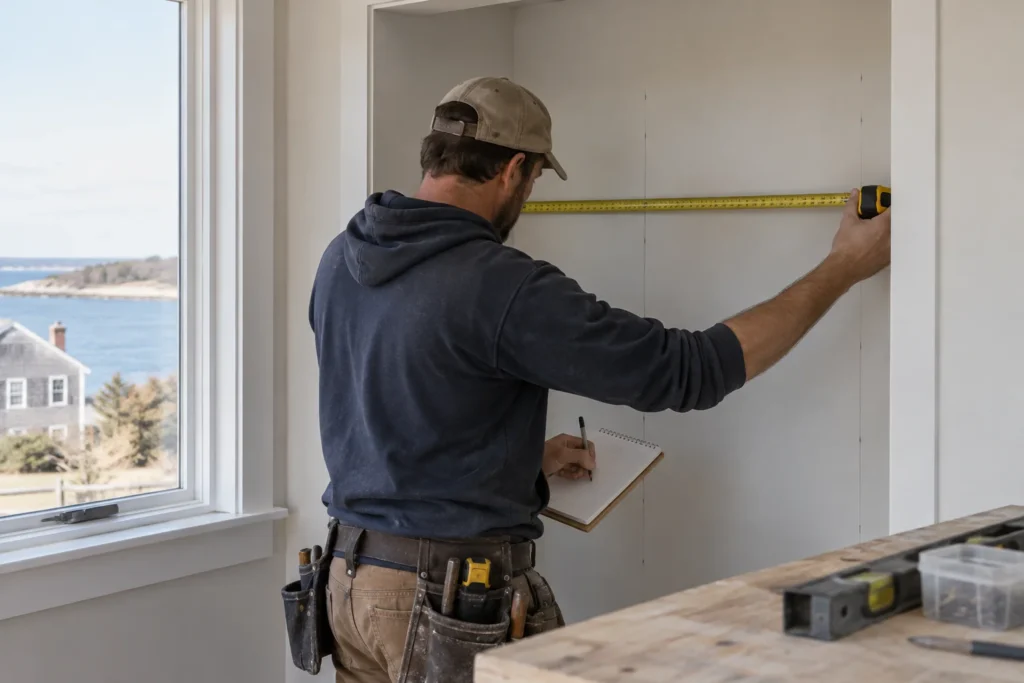
Carpenter pressing steel tape measure across alcove wall while marking stud locations on notepad. Illustrative image.

Planning · Phase One

Measuring and planning before fabrication starts

01

Consultation and design

We come to your home, assess the wall, ceiling, and floor conditions, and talk through how you want to use the shelving. We measure the actual opening or wall run, note where it is out of plumb or level, and sketch a layout that works with the room. You get a written scope before any material is ordered.

02

Material selection

We walk through wood species and sheet goods with you, paint-grade poplar or MDF for a painted finish, oak, maple, cherry, or walnut for a stained or natural look, and cabinet-grade plywood for the box carcasses. Load requirements, fixed versus adjustable shelving, and add-ons like doors or crown molding are decided here before fabrication starts.
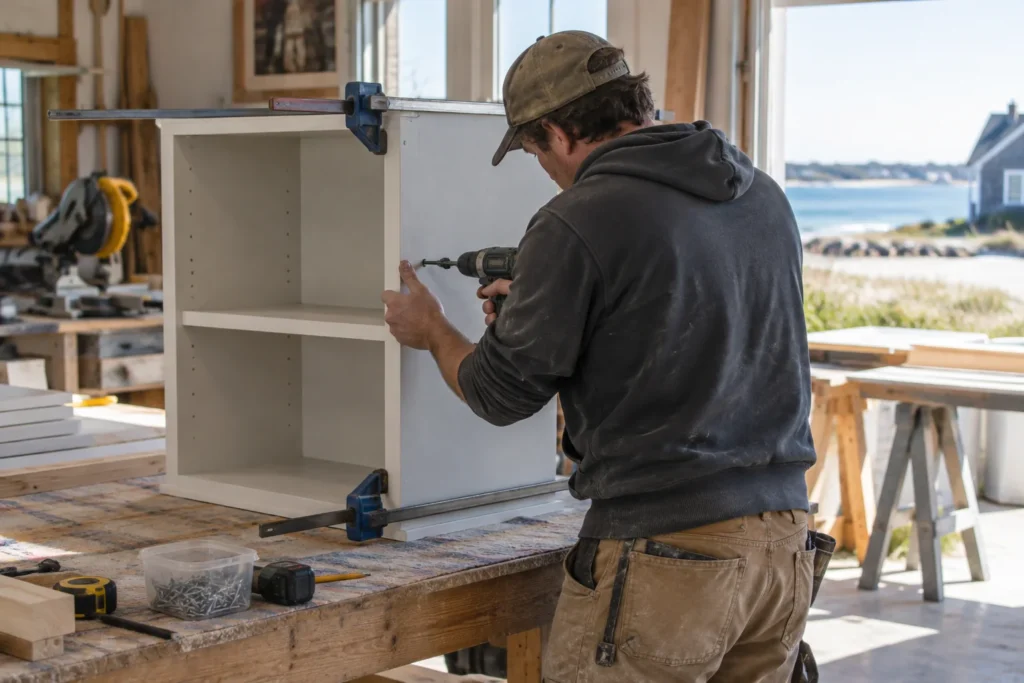
Woodworker assembling painted shelf cabinet carcass on shop workbench with clamps and screws. Illustrative image.

Fabrication · Phase Two

Building the unit in the shop before it comes to your home

03

Shop fabrication

Boxes, face frames, and shelving are cut and assembled in the shop. Dado and rabbet joints are used where the shelf carries real load. Pocket-hole joinery ties face frames to boxes. Pre-finish sanding, priming, and staining happen here where practical, before the unit ever arrives on site.

04

Fitting

Because Cape Cod homes, especially older ones, rarely have walls that are plumb or ceilings that are level, we scribe the unit to the actual room conditions on site. Scribe strips and trim pieces are cut to follow the wall and ceiling line so there are no visible gaps where the unit meets the room.

05

Fastening

The unit is fastened to studs or verified blocking, not just the drywall. French cleats or direct fastening to framing are used depending on the unit type. Floating shelves get concealed brackets or cleat systems sized for the intended load. Every shelf is checked level after fastening.
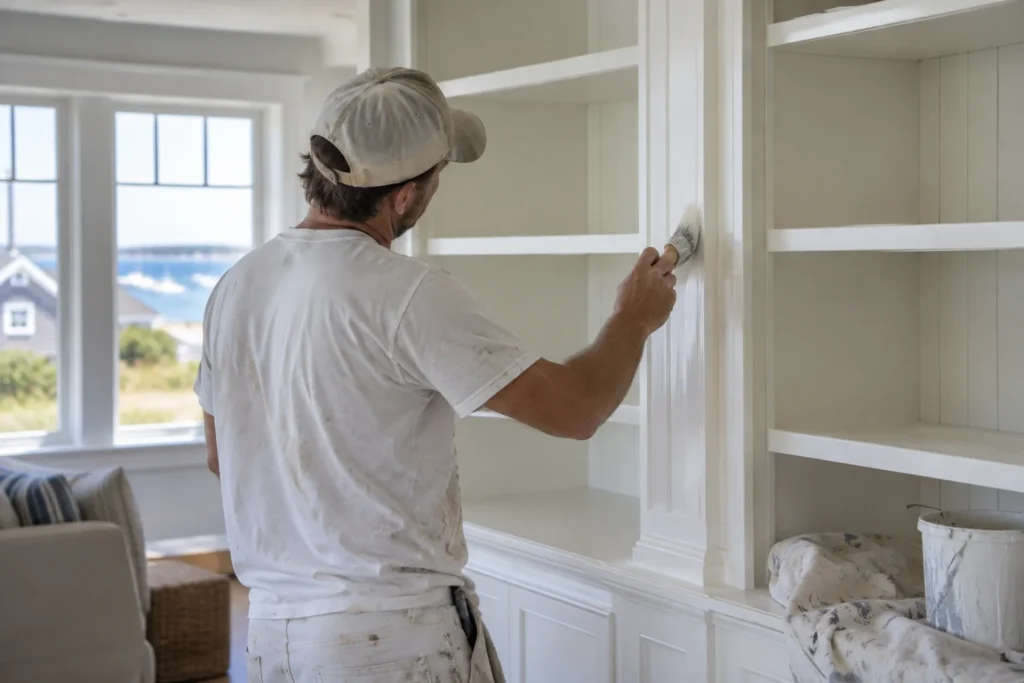
Carpenter applying final coat of white paint to built-in shelving trim inside finished room. Illustrative image.

Finish · Phase Three

Completing the finish and closing out the project

06

Final finish coats

Paint-grade work gets primer plus two finish coats. Stained or natural-wood work gets stain plus two to three coats of protective topcoat. Hardware, shelf pins, soft-close hinges, and any other specified hardware go on after the finish has cured. We match to your existing trim or cabinetry where specified.

07

Punch-list walkthrough

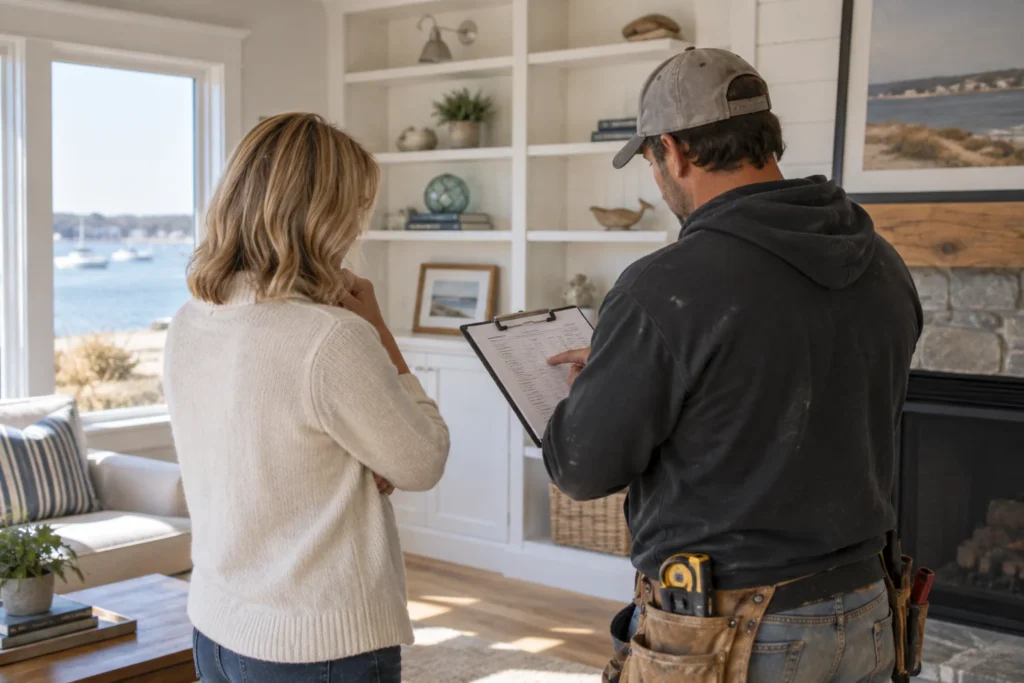
We walk the finished unit with you, check every shelf for level, look at every joint and scribe line, and confirm the finish matches scope. We do not call it done until you have seen it and agreed it is right.
Scope · What You Are Buying

What your shelving quote covers, and what it does not

A custom shelving quote from Forty One Construction covers the design consultation, measuring, material and hardware, shop fabrication, delivery, on-site installation and fastening to structure, scribing and trim to walls, and a standard paint or stain finish. Electrical work for integrated lighting, structural wall modifications, and refinishing of surrounding existing trim or walls are quoted separately rather than assumed into the number.

Included in the quote

  • Design consultation and measuring
  • Material, hardware, and shop fabrication
  • On-site installation and fastening to studs
  • Scribing and trim fitted to walls and ceiling
  • Standard paint or stain finish as specified
  • Shelf pins, hinges, and standard hardware
  • Crown molding or lighting unless specified

Not included, quoted separately

  • Electrical work for integrated lighting
  • Structural wall modifications or removal
  • Refinishing of surrounding existing trim or walls
  • Load-bearing wall assessment or engineering
  • Cabinet doors or drawers unless specified in scope

Done correctly means walls and ceilings checked for plumb and level before layout, shelves sized so unsupported spans stay within 30 to 36 inches for three-quarter-inch material before adding a center support or thicker stock, joints glued and mechanically fastened rather than nails alone, face frames and scribe strips fitted tight with no visible gaps, fasteners into studs or verified blocking, primer plus two finish coats for painted work, and lumber moisture content checked at 6 to 8 percent before installation to prevent warping or gapping later.

Homeowner and carpenter reviewing installed built-in shelving costs on clipboard in living room. Illustrative image.

Shelving Cost · Cape Cod

How much does custom built-in shelving cost on Cape Cod?

Custom built-in shelving on Cape Cod typically runs $150 to $450 per linear foot installed in 2026, with Forty One Construction quoting each project in Hyannis after an on-site visit. Hardwood species, joinery complexity, doors, drawers, and finish level all move the number toward the higher end.

Confirm the exact figure with us before planning, as market conditions can shift.

$30–$75 Per linear foot installed
$10K–$20K 2026 Hyannis and Cape Cod market

Cost Factors

What moves the price

The price moves with a handful of real drivers, including linear footage, unit height and depth, material choice, joinery type, finish level, and site conditions like out-of-plumb walls.

01

Linear footage and unit size

More running feet, greater height, or deeper shelves mean more material and more time in the shop and on site.

02

Material choice

Paint-grade MDF or poplar costs less than solid hardwood like oak, walnut, or cherry, both in material and in finish labor.

03

Joinery complexity

Fixed dado-jointed shelves take more shop time than an adjustable shelf-pin system. The tradeoff is load capacity.

04

Add-ons and finish level

Cabinet doors, drawers, crown molding, integrated LED lighting, and a stained topcoat each add material and labor to the total.

05

Site conditions

Walls far out of plumb or sloped ceilings in older Cape Cod homes add scribing and fitting time on site.

2026 Cost Guide

Typical shelving cost by scope

These ranges are a starting point for planning. Every project is quoted after an on-site measurement and assessment.

Job size / scope Typical range on Cape Cod (2026)
Single floating shelf run or simple fixed shelves Lower end of $150-$450 per linear foot
Standard alcove or fireplace-flanking built-in with face frame and trim Mid-range; complexity and material choice move it up or down
Full-wall or floor-to-ceiling system with doors, drawers, and finish Upper end; hardwood and finish details push higher

Every project is quoted after an on-site visit. Confirm figures before making budget decisions.

Get a Free Estimate →

Shelving Materials · Cape Cod

MDF, hardwood plywood, or solid wood: which material works best for a built-in?

The right material depends on your finish goal and how the shelving will be loaded. Paint-grade work and stained natural wood call for different substrates. Below are the main options we build with, compared honestly. Whatever the material, we check moisture content before installation so the unit does not move after the job is done.

Smooth white MDF board lying flat showing clean cut edge and no grain. Illustrative image.

Paint Grade · Entry Tier

Paint-grade MDF or poplar

The most common choice for built-ins that will be painted. MDF holds paint well, machines cleanly, and stays flat. Poplar is used for face frames and trim where a solid edge is needed. Neither is suited to a stained finish, but for painted work they are the practical choice and cost less than hardwood.
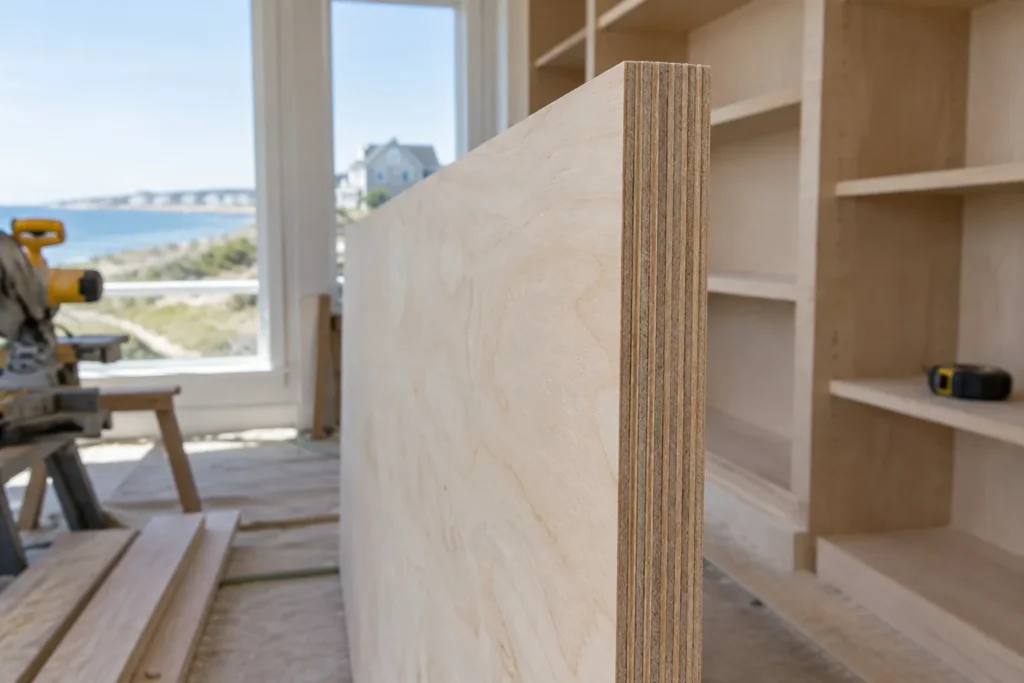
Plywood sheet standing upright revealing multiple thin laminated core layers at edge. Illustrative image.

Sheet Goods · Workhorse

Cabinet-grade plywood

AC, AB, or Baltic birch plywood is used for box carcasses across all finish levels. It is stable, strong, and holds fasteners well. Baltic birch is especially flat and consistent, which matters when boxes need to be perfectly square. It can be painted or veneered depending on the finish spec.
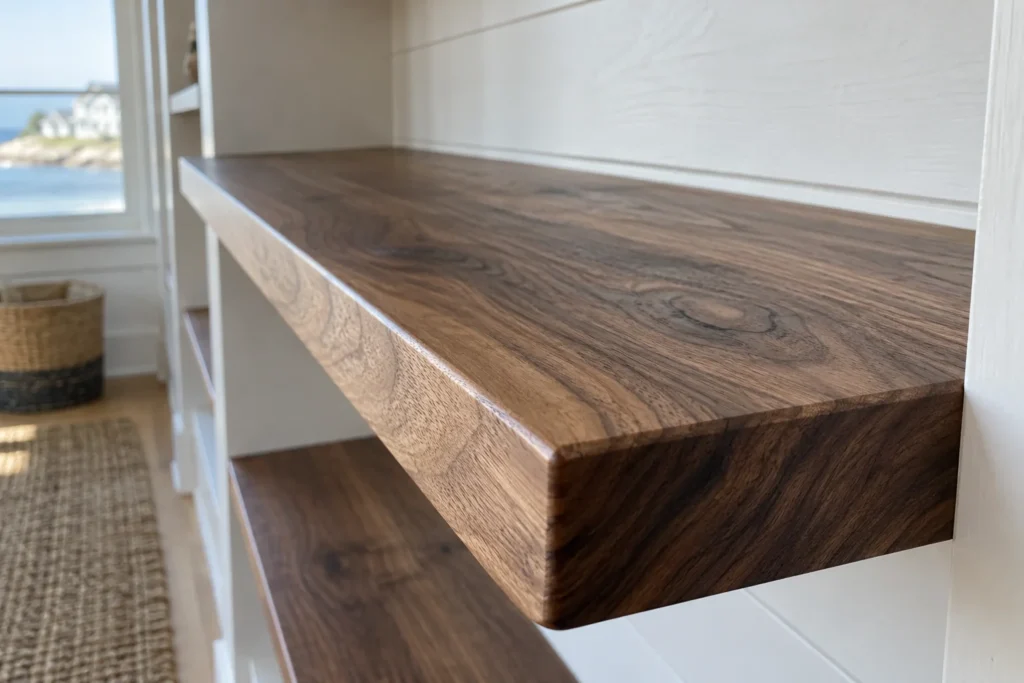
Walnut hardwood plank showing rich figured grain and cleanly routed edge profile. Illustrative image.

Solid Wood · Natural Finish

Solid hardwood

Oak, maple, cherry, and walnut are the common choices for stained or clear-coat work. Each species takes stain differently. Oak has an open grain that reads through the finish; walnut is darker and more uniform; maple is tight-grained and even. Species choice matters more than most people expect once the topcoat is on.

Small metal shelf pins arranged beside a drilled shelf panel with evenly spaced holes. Illustrative image.

Adjustable · Flexible

Shelf-pin systems

A shelf-pin or track system lets shelves be repositioned without rebuilding the unit. It is the right call where the contents will change, for books at one height today and something taller tomorrow. The tradeoff versus a dado-jointed fixed shelf is load capacity at longer unsupported spans.

Keyhole floating bracket mounted flush against a painted wall cleat showing hidden hardware depth. Illustrative image.

Mounting · Wall-Hung

Floating and cleat-mounted

Floating shelves use concealed brackets or French cleats fastened to studs or blocking. They read as shelves without a visible box beneath them. Load capacity depends on the bracket spacing, the fastener into the stud, and the shelf depth. We size the mounting to the intended load rather than using a standard bracket for every application.

Material Comparison

Compare shelving material options

Compare where each material fits best, how it performs for a built-in, and what finish it suits.

Option Best for Finish compatibility Load capacity
Paint-grade MDF Painted built-ins Paint only Good
Cabinet-grade plywood Box carcasses Paint or veneer Very good
Solid hardwood Stain or clear coat Stain or paint Excellent
Shelf-pin system Adjustable storage Any finish Good
Floating/cleat Wall-hung, no visible box Any finish Moderate

We match the material to the finish goal and the load. If a paint-grade material is the practical call for your room, we will tell you. If you want solid walnut, we will tell you what that adds and what you are getting for the difference.

Carpenter checking wall-mounted shelf bracket alignment with level during timed installation sequence. Illustrative image.

Project Timeline · Cape Cod

How long does it take to build custom shelving on Cape Cod?

A custom shelving project with Forty One Construction takes anywhere from one to two days on site for a simple single-run shelf installation, three to five days including shop fabrication and on-site install for a standard alcove or wall built-in, and one to two weeks for a full-wall or floor-to-ceiling system with doors, trim, and multiple finish coats.

Two things stretch that window here. Shop backlog and finish cure time add days between fabrication and installation, and we build that honestly into the schedule rather than promising a date we cannot hold. Summer on Cape Cod also compresses booking from Memorial Day to Labor Day, when demand from seasonal homeowners peaks. If your project needs to be done before summer, scheduling early in the year is the practical move.
3–5 days Simple shelf run · 1-2 days on site
1–2 weeks Standard built-in · 3-5 days with fabrication
3–5 weeks Full-wall system · 1-2 weeks with finish
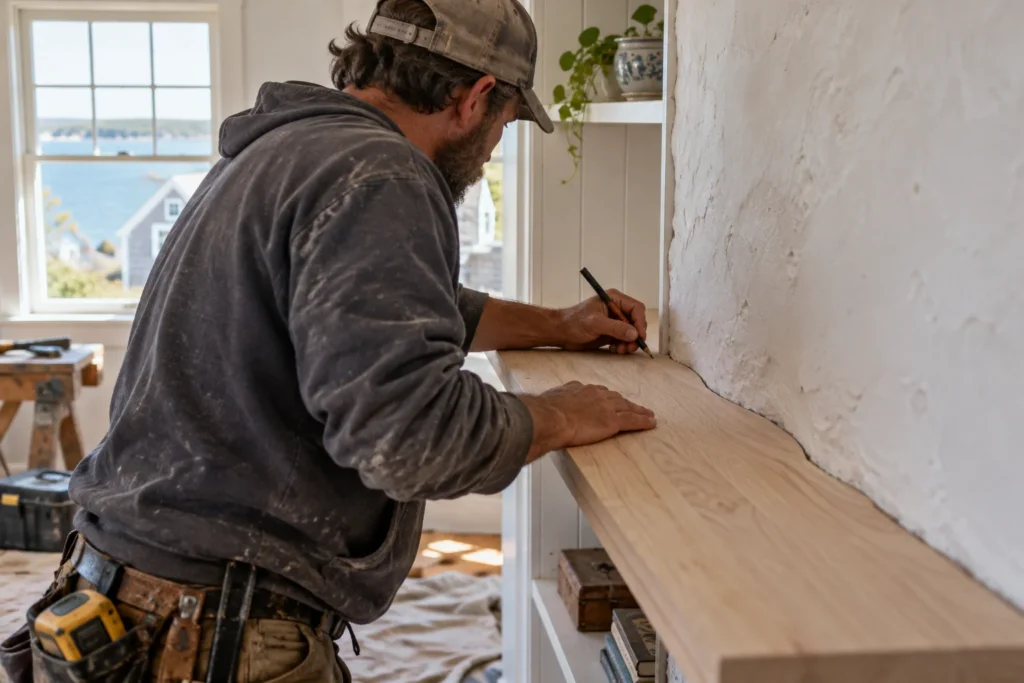
Carpenter scribing shelf panel edge to fit uneven plaster wall in older Cape Cod home. Illustrative image.

Installation Detail · Cape Cod

What fitting a built-in to a Cape Cod home actually requires

The installation is where a shop-built unit becomes a built-in. A box that is square and flat in the shop still has to fit a wall that may not be either. On Cape Cod, older homes in particular have walls out of plumb, ceilings that slope, and floors that are not level. Getting the unit to read as part of the room rather than furniture against the wall is a scribing and fitting problem, not just a fastening one.

Wall Conditions

Checking plumb, level, and framing

Before any unit goes up, we check the wall for plumb and level and locate studs or blocking. Walls in older Cape Cod homes can be significantly out of plumb, which means the face of the unit has to be held level and the gaps scribed out with trim rather than the whole unit tipped to follow the wall. Skipping that step produces a unit that looks wrong the moment it is in the room. We also check lumber moisture content before installation, ideally 6 to 8 percent for interior finish work, because wood installed too wet in a humid Cape Cod summer will shrink and gap as it dries.

Fastening Method

Fastening to studs or blocking

Wall-mounted units are fastened to studs or verified blocking, not drywall alone. French cleats distribute load across multiple stud bays and allow the unit to be repositioned if needed. Direct fastening into studs is used for face-framed built-ins where the cleat would be hidden behind the unit. Floating shelves use concealed brackets sized for the intended load and fastened into studs. Shelves are sized to avoid sag under their rated load, typically no more than 30 to 36 inches unsupported for three-quarter-inch material before adding a center support or stepping up to thicker stock. Joints are glued and mechanically fastened, not nailed alone, and face frames and scribe strips are fitted tight with no visible gaps at the wall, ceiling, or floor line.

Service Life · Interior Conditions

How long does a custom built-in last in a Cape Cod home?

The joinery and the installation decide it, not the wood species. A unit with dado-jointed fixed shelves, glued and mechanically fastened, fastened to studs, and finished with a protective topcoat will outlast a pin-supported unit assembled with nails alone. We do not publish a single lifespan figure because the honest answer depends on the material, the joinery, and how the room is used.

  • Humid summers affect wood that was not acclimated. Interior trim and shelving installed without letting the material reach the room's moisture level will move after the job is done. We check moisture content before installation.
  • Unsupported span causes sag. A shelf loaded beyond what the material and span can carry will deflect over time. We size shelves to prevent sag under the intended load before the unit leaves the shop.
  • Finish protects the wood. Paint-grade work gets primer plus two finish coats. Natural wood gets stain plus two to three coats of protective topcoat. An unfinished or thinly finished surface shows wear faster and is harder to clean.
  • Joints matter more than looks. A glued and mechanically fastened joint at a dado or rabbet stays tight. A nailed butt joint can open over time, especially in a room that sees seasonal humidity swings common on Cape Cod.

Forty One Construction backs labor and installation with a 5-year workmanship warranty. Manufacturer warranties on materials and hardware are provided separately by the manufacturer and vary by product.

Local Carpenter · Cape Cod

Where we build custom shelving across Cape Cod and the South Shore

Forty One Construction builds custom shelving across Cape Cod from our office in Hyannis. Older homes throughout the service area present the same fitting challenges: walls out of plumb, ceilings that slope, and rooms where nothing is quite square. A built-in that fits the room properly has to be scribed to the actual conditions, not installed assuming the walls are flat.

We serve homeowners from the outer Cape through the canal, Provincetown, Truro, Wellfleet, Eastham, Orleans, Chatham, Brewster, Harwich, Dennis, and Yarmouth on one side, and Hyannis, Centerville, Osterville, Cotuit, Mashpee, Falmouth, Bourne, Sagamore, Sandwich, and Barnstable through the mid- and upper Cape, along with Plymouth. See our work in Hyannis and Barnstable.

Hyannis Home Base
Cape Cod Local Coverage
Plymouth South Shore
Carpenter unloading prefabricated shelf cabinet from van in driveway of coastal Cape Cod house. Illustrative image.

Credentials · Accountability

What to verify before your project starts

Credentials

License and coverage you can verify

Daniel Araujo holds a Massachusetts Construction Supervisor License (CSL), Unrestricted (#CS-123114), and the company holds Home Improvement Contractor registration #217279. We carry $1,000,000/$2,000,000 general liability coverage, and a certificate of insurance is available on request. The numbers are printed so you can check them. Learn more about us.

Permits · Code

We pull the permit and build to code

We submit drawings to the Town of Barnstable Building Division and pull the permit in our name. Footings reach frost depth, ledgers get through-bolted and flashed, and every connection is built to pass framing and final inspection, not just to look finished.

Before Construction

A written scope before we order a board

You get a written scope up front, so the number in your hand is tied to specific materials and work, not a vague figure that grows halfway through. When quotes look interchangeable on paper, that's usually where the real difference sits.
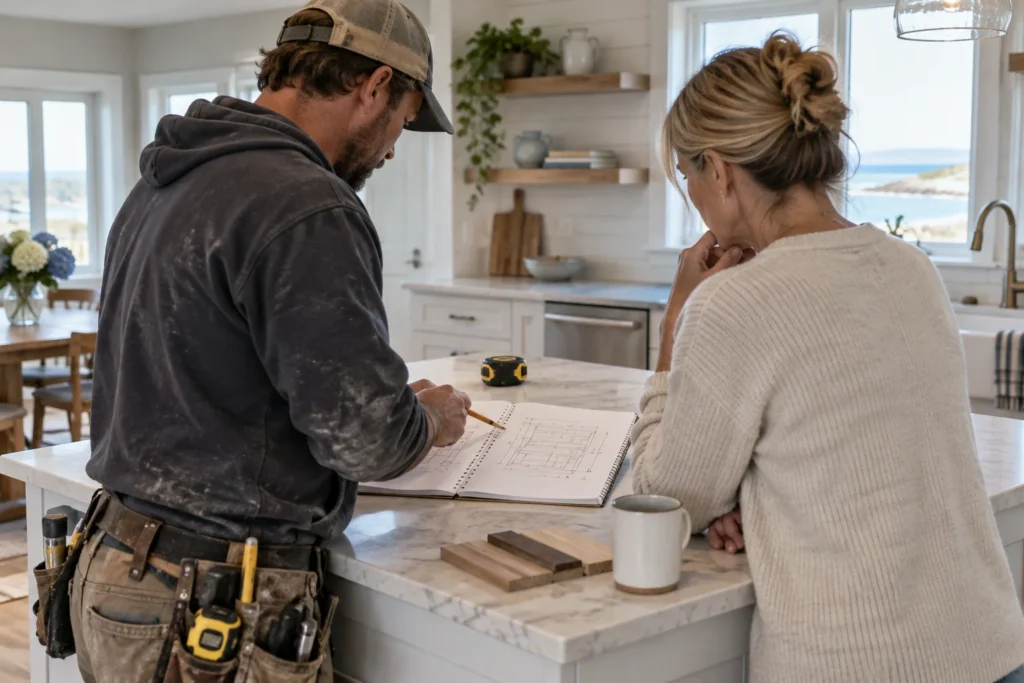
Carpenter and homeowner standing at kitchen island reviewing handwritten shelving scope before work begins. Illustrative image.

Client Testimonials

Real clients. Their own words.

Hear directly from our clients about their experience working with Forty One Construction. Select a video to watch their story.

Forty One Construction · Client Stories Click to play · Sound on

Homeowner Reviews

What homeowners in Hyannis say

Forty One Construction holds a 5-star rating across 51 Google reviews.

5.0 ★★★★★ Google Reviews
★★★★★ Google
“From the first walkthrough to the final cleanup, their professionalism stood out. They explained every step clearly, offered smart recommendations…”
Brian Timmins Google review excerpt Google
★★★★★ Google
“We are enjoying our deck and patio and we love the fresh look our house now has.…”
Stephanie York Google review excerpt Google
★★★★★ Google
“Outstanding communication, craftsmanship, customer care and pricing. I would recommend them for any home improvement project, large or small.…”
RedBalloon Google review excerpt Google

Custom Decks · Cape Cod

Questions about custom shelving installation

How much deposit do you require before you start building my shelving?

Massachusetts consumer guidance advises against paying more than one-third upfront unless special-order lumber or hardware is required. Because custom shelving involves shop fabrication before any site work begins, we structure payments around that written scope. We will walk through the payment schedule before you sign anything.

What wood species and materials do you work with?

We work with paint-grade poplar and MDF for painted finishes, and oak, maple, cherry, and walnut for stained or natural finishes. Cabinet-grade plywood, including AC/AB and Baltic birch, is standard for box carcasses. Hardware includes standard shelf-pin systems, soft-close hinges, and concealed floating-shelf brackets. We spec the material to the finish goal and the load the shelving will carry.

Where will the crew work, and will the installation disrupt my home?

Most of the work happens in the shop before anything arrives at your home. On-site installation is cleaner and faster as a result. Our crew stages tools and materials in the room being worked on and keeps the rest of the house clear. Dust from scribing and final fitting is contained to the work area. Summer traffic on Route 28 and Route 6 can shift arrival times, and we account for that in scheduling.

What should I clear out or prepare before the shelving crew arrives?

Remove furniture and stored items from the wall area where the unit will be installed. Beyond that, no preparation is needed. If finish components require a specific room temperature to cure properly, or if an existing outlet or fixture needs to be relocated first, we flag that during the design consultation.

What if something is not right after the shelving is installed?

Every installation carries a 5-year workmanship warranty on labor and installation. Manufacturer warranties on materials are provided separately by the manufacturer. If something is not right with our work, call us, we come out and look at it at no charge, and if it is our error, we fix it at no cost to you.

Why should I pay more for your shelving bid than a cheaper competitor's?

The difference typically lives in the joinery and fitting. Face frames scribed tight to an out-of-plumb Cape Cod wall rather than filled with caulk, shelves joined with dado or rabbet cuts rather than nails alone, and a written scope that defines what happens when walls are not square are what separate a lasting installation from one that shifts.

Do I need a permit to install built-in shelving in Hyannis?

Built-in shelving is typically interior finish carpentry and does not require a building permit in most cases. If the project involves structural wall modifications or removal of load-bearing elements, that work would require a permit. We will tell you at the consultation whether any permit is needed for your specific scope.

When is the best time of year to have shelving installed on Cape Cod?

Interior carpentry work can run year-round, which is an advantage over exterior projects. The main scheduling consideration is summer demand. The Cape's population increases significantly from Memorial Day to Labor Day, and that is when booking fills fastest. Shoulder seasons in spring and fall tend to offer more flexible scheduling windows.

Free On-Site Estimate

Get a Quote

Ready to talk through your project? Forty One Construction will come out, look at your yard, and give you a written scope tied to real materials and a real number. Every install carries a 5-year workmanship warranty on labor and installation, with manufacturer warranties on materials provided separately by the manufacturer.

Our crew builds across Hyannis and Cape Cod, and our office is at 76 W Main St Unit 306, Hyannis, MA 02601. Call us or request an estimate and we'll get you on the calendar honestly, weather and permits accounted for.

Free Estimate
Owner-Led Service
Serving Cape Cod

No-pressure consultation · Clear upfront pricing