Siding installation on Cape Cod

Siding installation is the full replacement or new application of exterior cladding on a home: old siding stripped to the sheathing, a water-resistive barrier and flashing installed, and new siding hung plumb with correct fastening, expansion gaps, and trim details for a weathertight building envelope.

It is the right call when existing cladding is failing, when water has worked behind the wall, or when a home needs a fresh exterior that can handle coastal conditions. On Cape Cod the details decide how long it lasts: salt air corrodes the wrong fasteners, wind-driven rain finds every gap in the flashing, and unsealed end grain splits through the first freeze-thaw cycle.

Daniel Araujo holds a Massachusetts Construction Supervisor License (CSL), Unrestricted (#CS-123114), and Forty One Construction is a BBB Accredited Business. We carry 51 Google reviews at 5 stars.

This page covers what a siding installation includes, what it costs in 2026, how the material options compare in a coastal climate, and what the wall assembly behind new Cape Cod siding actually requires.

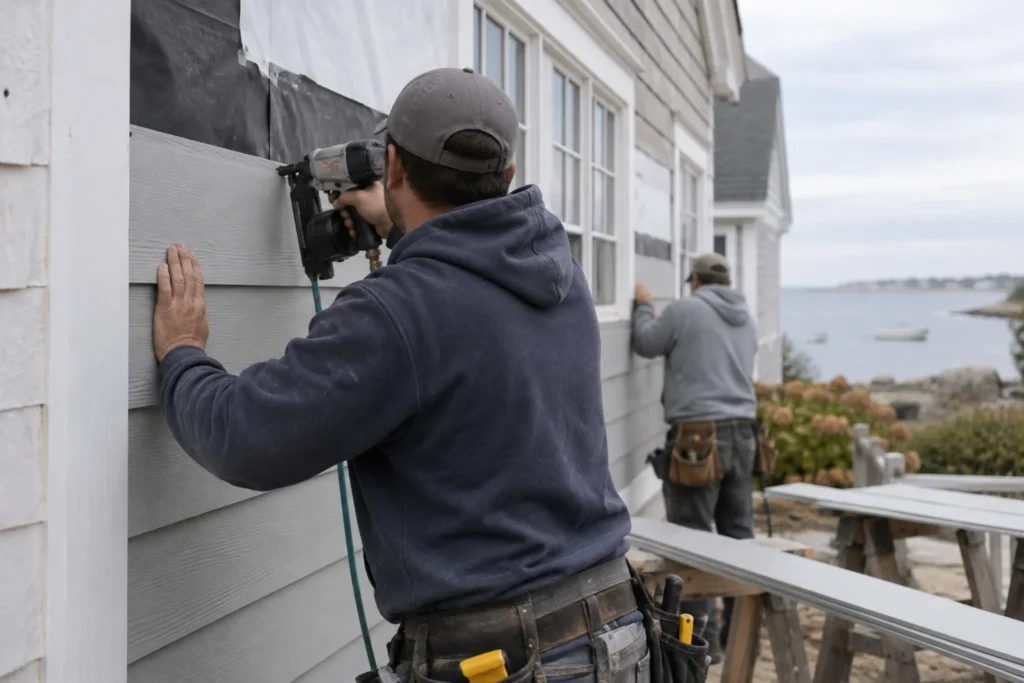
Crew members nailing fiber cement panels onto a Cape Cod colonial exterior wall. Illustrative image.

Massachusetts License

CS-123114

MA CSL · Unrestricted

Home Improvement

217279

MA HIC Registration

Accreditation

BBB

Accredited Business

Google Reviews

5 Stars

51 Google Reviews

Project Planning

Free

On-Site Estimates

Before You Start · Cape Cod

How do I know if my siding needs to be replaced rather than patched?

If the sheathing behind the cladding is wet or rotting, patches only delay the real fix. Surface problems are worth repairing. Problems that have reached the wall assembly are not, because money spent on patches goes into something already compromised.

  • It bubbles or buckles. Panels that have warped away from the wall are letting water in at the seams and holding it against the sheathing behind.
  • Rust streaks. Stains bleeding from nails or trim screws mean corroding fasteners. Salt air does that to anything not stainless or properly coated.
  • Soft wall near windows or doors. Spongy sheathing at penetrations means water has been getting behind the cladding at the flashing details, not the middle of the wall.
  • Paint that won't hold. Finish that peels repeatedly in the same spots usually means moisture is pushing out from behind the siding, not just a paint problem.
  • Gaps at corners or trim. Open joints at corner posts, J-channel, or trim let wind-driven rain in. On the Cape, rain arrives sideways and finds every gap.
  • Visible rot at the bottom course. The starter strip and lowest course take the most abuse. Rot there usually means water has been wicking up behind the wall for more than one season.

The one you cannot see matters most. Water that gets behind siding does so at the details, not the middle of the wall. A missing kick-out flashing at a roof-wall intersection or an unflashed window can saturate the sheathing for years before anything shows on the surface. If you have had interior staining near an exterior wall, find out where the water is entering before re-siding.

Siding Installation · Cape Cod

What a siding installation includes from first measurement to final walkthrough

A siding installation with Forty One Construction runs through seven phases, from the first on-site measurement to the final inspection and walkthrough in Hyannis. Every phase has a clear purpose, and you sign off before we move to the next stage. Here is what each one covers.

Contractor measuring a gable wall and marking layout lines before any material arrives. Illustrative image.

Planning · Phase One

Planning the installation before materials are ordered

01

Measurement and material selection

We come to your home, measure each wall, note the number of stories, windows, doors, and trim details, and discuss which siding material fits your goals and budget. You get a written scope before anything is ordered or permitted.

02

Permit and material order

We prepare the permit application and submit it to the Town of Barnstable Building Division, which governs the work under 780 CMR, the Massachusetts State Building Code. The permit is pulled in our name. Materials are ordered once the scope is confirmed and lead times are known.

Worker stapling house wrap over sheathing before the first siding course goes up. Illustrative image.

Installation · Phase Two

Preparing the wall and installing the new cladding

03

Tear-off and sheathing inspection

Our crew strips the old cladding down to the sheathing, removes trim and flashings, and inspects the wall. Any rotted or water-damaged plywood or framing is repaired before the new wall assembly goes on. Skipping this step is the most common hidden shortcut in re-siding work.

04

House wrap and flashing

A water-resistive barrier goes on shingle-style, upper laps over lower, and is taped at seams. Kick-out flashing, drip cap, and window and door flashings are installed at every penetration. On the Cape, wind-driven rain arrives sideways, so every lap and detail gets real attention before the first panel goes up.

05

Siding installation

Starter strips, corner posts, and the first course go on level and plumb. Each subsequent course is fastened per the manufacturer nailing pattern with the correct reveal and a 1/32-inch expansion gap so panels can move through a humidity cycle without buckling.

Installer pressing trim boards tight into corner returns as the final siding course finishes. Illustrative image.

Finish · Phase Three

Completing the trim details and closing out the project

06

Trim and detail work

J-channel, utility trim, corner posts, soffit and fascia details, and caulk at all clean penetrations go on after the field panels are set. These are where wind-driven rain gets in if the work is cut short, so we treat them as the most important part of the finish stage.

07

Final inspection and walkthrough

The building inspector signs off, we clean the site and haul away all debris, and we walk the finished exterior with you. You see the work, ask questions, and we do not call it done until you agree it is.
Scope · What You Are Buying

What your siding quote covers, and what it does not

A siding installation quote from Forty One Construction covers tear-off and disposal of old cladding, sheathing inspection and minor repair, house wrap and flashing, new siding and trim installation, and cleanup. Major framing repairs, window or door replacement, gutter work, and permit fees in some markets are quoted separately rather than assumed into the number.

Included in the quote

  • Tear-off and disposal of old siding
  • Permit drawings and submission to your town
  • Sheathing inspection and minor rot repair
  • House wrap, flashing at all windows, doors, and penetrations
  • New siding, trim, and corner post installation
  • J-channel, soffit and fascia detail work
  • Manufacturer warranty registration

Not included, quoted separately

  • Major structural or framing repair
  • Window or door replacement
  • Gutter replacement or re-hanging
  • Painting of unprimed trim boards
  • Permit fees where passed through as a line item

Done correctly means WRB lapped shingle-style with upper over lower and a minimum 2-inch horizontal and 6-inch vertical overlap, taped at seams; kick-out flashing and drip cap installed at all roof-wall intersections; siding fastened per manufacturer nailing pattern with the correct reveal and a 1/32-inch expansion gap; panels level, plumb, and straight with consistent coursing; and a local building permit and inspection pulled where required. Those are not preferences. They are what the inspection checks.

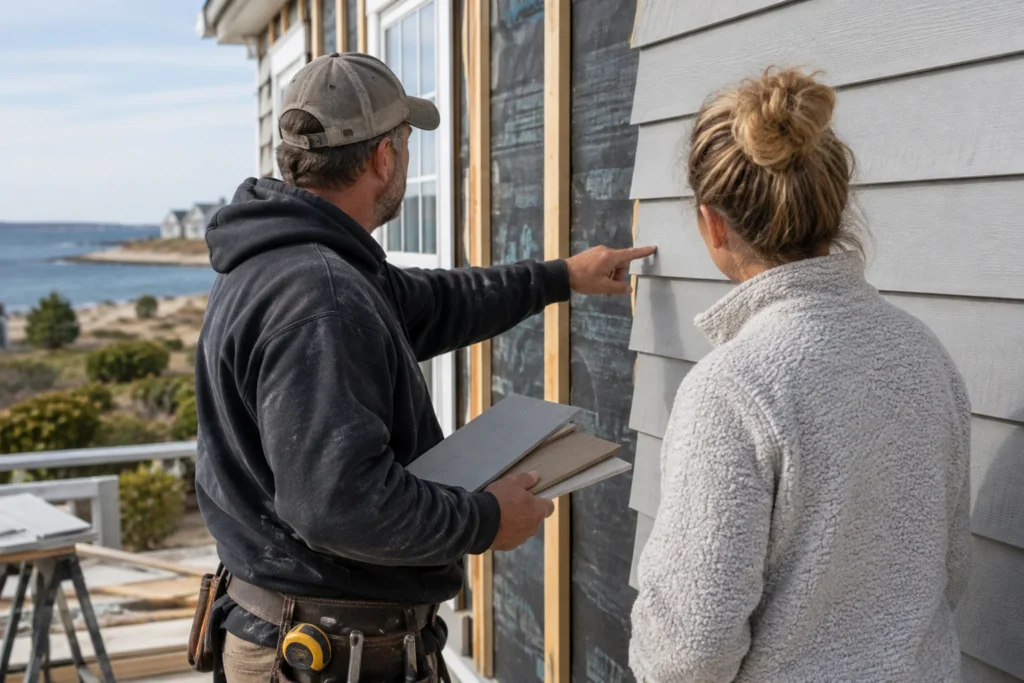
Homeowner and contractor standing beside a partially sided wall discussing material choices. Illustrative image.

Siding Cost · Cape Cod

How much does siding installation cost on Cape Cod?

Siding installation on Cape Cod typically runs $9 to $26 per square foot installed in 2026, with Forty One Construction quoting each job in Hyannis after an on-site visit. Fiber cement and premium wood or composite materials land at the higher end; vinyl runs the lower end of that range.

The installed price per square foot varies with material choice, wall complexity, and site conditions.

$30–$75 Per square foot installed
$10K–$20K 2026 Hyannis and Cape Cod market

Cost Factors

What moves the price

The price moves with a handful of real drivers, including material choice, home size and stories, wall complexity, tear-off versus overlay, and sheathing condition.

01

Material choice

Vinyl runs the lower end; fiber cement and premium wood or engineered options cost more per square foot installed.

02

Home size and number of stories

More wall area and more stories mean more material, more labor, and scaffolding or staging for upper floors.

03

Wall complexity

Dormers, gables, bump-outs, and heavy trim detail all add cutting, fitting, and time compared to a flat wall.

04

Tear-off versus overlay

Stripping old siding adds disposal cost but lets us inspect the sheathing. Installing over existing cladding costs less where code and condition allow.

05

Sheathing and site conditions

Rot or water damage found under old siding adds repair cost. Tight lots or multi-story work may require staging.

2026 Cost Guide

Typical siding cost by scope

These ranges are a starting point for planning. Every job is quoted after an on-site assessment.

Job size / scope Typical range on Cape Cod (2026)
Single-wall or storm-damage section repair Lower end of $9-$26/sq ft installed
Average single-family home (1,500-2,500 sq ft), full re-side Mid-range; material choice drives where in the window
Larger or architecturally complex home with full tear-off Upper end; sheathing repair and staging add to total

Permit and inspection lead time factor in too. Every job is quoted after an on-site assessment.

Get a Free Estimate →

Siding Materials · Cape Cod

Vinyl, fiber cement, or wood: which siding material holds up in a coastal climate?

The right siding material depends on your budget and how much maintenance you want, but within a mile or two of salt water, and on Cape Cod most of us are, the fasteners matter as much as the panels. Below are the main material options we install, honestly compared. Whatever the cladding, we use stainless or hot-dip galvanized fasteners so nothing bleeds rust down your new siding.

A single vinyl siding panel laid flat showing its hollow back and ribbed face. Illustrative image.

Vinyl · Entry Tier

Vinyl siding

The lowest-cost option and one of the most common. It resists moisture and salt air well and needs no painting, but lighter gauges can crack in cold or dent on impact. Best for homeowners on a tighter budget who want low maintenance. We install .040 gauge and heavier; thinner material does not hold up on coastal exposures.

A single fiber cement siding plank on edge showing its thick solid cross section. Illustrative image.

Fiber Cement · Coastal Workhorse

Fiber cement siding

James Hardie HardiePlank and HardieShingle and similar fiber cement products are dense, dimensionally stable, and hold paint well. They resist moisture, rot, and impact, and handle salt air without corroding. Best for homeowners who want a wood look without the maintenance. End cuts need to be primed and sealed on site to prevent moisture intrusion.

A single engineered wood siding plank showing its textured face and cut end grain. Illustrative image.

Engineered Wood · Mid-Range

Engineered wood siding

LP SmartSide and similar products use a treated wood-fiber core that resists rot better than natural wood but still needs painted edges and sealed end cuts. Best for homeowners who want a natural wood appearance at a lower price than clear cedar. On Cape Cod, sealing every field cut matters more than it does inland because freeze-thaw will find any open end grain.

A split cedar shingle beside a flat cedar clapboard showing raw wood grain and taper. Illustrative image.

Cedar · Natural Classic

Cedar shingle and clapboard

Western Red or White cedar is naturally rot-resistant and a regional standard here. It weathers to soft gray if left alone or holds color with a finish. Best for homeowners who want an authentic Cape Cod look. Galvanized nails bleed rust down new cedar within a season or two; we fasten cedar with stainless only, which is the single detail that separates work that still looks right in year three from work that does not.

A length of PVC trim board standing upright showing its smooth white face and dense cut edge. Illustrative image.

PVC Trim · Coastal Detail

PVC trim boards

AZEK, Versatex, and similar cellular PVC trim products are all plastic, no wood fiber. They do not rot, absorb moisture, or corrode, and they hold paint far longer than wood trim. Best for window surrounds, corner boards, and soffit details in high-exposure coastal locations. They cost more than wood trim up front and expand and contract with temperature, so fastening details matter.

Material Comparison

Compare siding options

Compare where each material fits best, how it performs in Cape Cod salt air, and the level of maintenance it requires.

Option Best for Holds up to salt air Maintenance
Vinyl (.040+ gauge) Tight budgets Good (no corrosion) Low
Fiber cement Low maintenance, wood look Very good with sealed cuts Low to medium
Engineered wood Natural look, mid price Good with sealed ends Medium
Cedar shingle or clapboard Authentic Cape Cod look Good with stainless fasteners Medium to high
PVC trim High-exposure detail work Excellent Very low

We name real brands when we spec a job, fiber cement from James Hardie, engineered wood from LP SmartSide, vinyl from CertainTeed, Mastic, Royal Building Products, Alside, and PVC trim from AZEK or Versatex. If a less expensive material is the right call for how you will use the home, we will tell you.
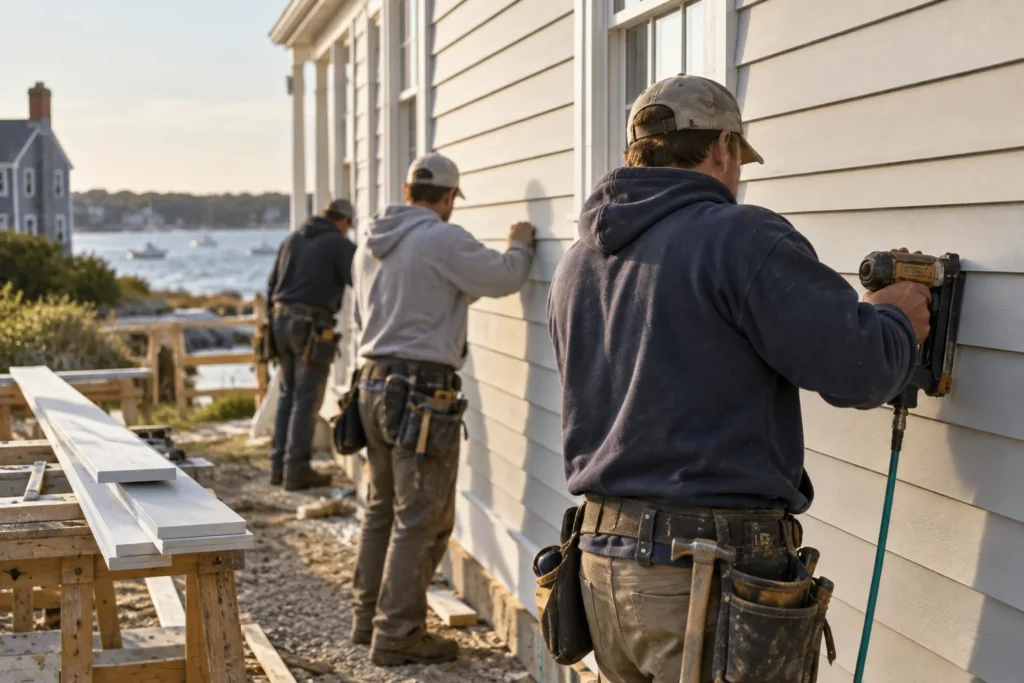
Crew working steadily along a long run of freshly installed clapboard in afternoon light. Illustrative image.

Project Timeline · Cape Cod

How long does a siding installation take on Cape Cod?

A siding project with Forty One Construction takes anywhere from 1 to 2 days for a single-wall or storm-damage repair, 4 to 7 working days for an average single-family home of 1,500 to 2,500 square feet, and 1.5 to 3 weeks for a larger or architecturally complex home with full tear-off and sheathing repair, plus permit and material lead time before work begins.

Three things stretch that window here. Permit review at the Town of Barnstable Building Division adds lead time before the first panel goes up. Weather limits exterior work, freeze-thaw from roughly November through March and nor'easters through the same stretch cost days when fresh caulk or house wrap tape cannot cure properly. And summer traffic on Route 28 and Route 6 between Memorial Day and Labor Day affects crew arrival and material delivery, which we build into an honest schedule rather than promising a date we cannot hold.

3–5 days Single wall or section repair: 1-2 days
1–2 weeks Average home (1,500-2,500 sq ft): 4-7 days
3–5 weeks Larger or complex home with tear-off: 1.5-3 weeks
Worker fitting rigid insulation between furring strips behind new siding on a coastal home. Illustrative image.

Wall Assembly · Cape Cod

What the wall assembly behind new Cape Cod siding actually requires

The wall assembly is everything behind the panels you see, sheathing, house wrap, and flashing, and it is where a re-side is done right or done wrong. On Cape Cod, two details decide whether the new exterior protects the house: how the water-resistive barrier is lapped, and how every penetration is flashed. Get either wrong and water works behind the cladding at the first nor'easter.

Water Barrier

House wrap and WRB installation

A water-resistive barrier like Tyvek or Typar goes on shingle-style over the sheathing, upper laps over lower, with a minimum 2-inch horizontal and 6-inch vertical overlap, and seams taped. Wind-driven rain on the Cape arrives sideways and does not give a poorly lapped WRB the benefit of the doubt. We lap and tape every seam before the first panel goes up, because fixing a WRB detail after the siding is on means taking the siding back off.

Flashing Details

Kick-out, drip cap, and window flashing

Kick-out flashing diverts water away from wall intersections at roof edges, where a missing piece can saturate the sheathing behind the siding for years before anything shows inside. Drip cap over windows and doors keeps water from running behind the casing. Window and door rough openings get flashed before trim goes on. These are the spots where water gets behind siding on Cape Cod homes, not the middle of the wall, and they get the most attention in our installation process.

Service Life · Coastal Exposure

How long does new siding last on Cape Cod?

The wall assembly decides it, not the color of the panels. Siding installed over a properly lapped WRB with stainless fasteners and fully flashed penetrations outlasts siding applied over a compromised wall. We do not publish a single lifespan figure, because the honest answer depends on the material, the exposure, and the maintenance, and a number that ignores all three is not useful information.

  • Salt air attacks fasteners first. The entire service area sits within a few miles of salt water. Galvanized nails bleed rust down new cedar within a season or two. Stainless does not, and that single choice separates work that still looks right in year three from work that does not.
  • Freeze-thaw finds every unsealed cut end. Water that gets into an open joint or unprimed end grain freezes, expands, and splits the material, roughly November through March, and it starts with the first winter after install.
  • Wind-driven rain finds gaps at the details. Water does not get behind siding in the middle of the wall. It gets in at the window heads, kick-out intersections, and anywhere caulk is missing or flashing is wrong.
  • Maintenance that extends the life. Keep caulk joints intact at trim and penetrations, repaint or refinish on schedule for wood and fiber cement, and check that weep holes at the bottom of the wall stay clear so any water that does get in has a path out.

Forty One Construction backs labor and installation with a 5-year workmanship warranty. Manufacturer warranties on siding and trim products are provided separately by the manufacturer and vary by product.

Local Siding Contractor · Cape Cod

Where we install siding across Cape Cod and the South Shore

Forty One Construction installs siding across Cape Cod from our office in Hyannis, and the coastal conditions shape every project. Salt air corrodes the wrong fasteners within a season or two, wind-driven rain gets behind cladding at the details rather than the field, and the humid summers here mean house wrap and flashing matter more than they do on an inland job. Siding installed for the Cape's climate is not the same as siding installed for inland Massachusetts.

We serve homeowners from the outer Cape through the canal, Provincetown, Truro, Wellfleet, Eastham, Orleans, Chatham, Brewster, Harwich, Dennis, and Yarmouth on one side, and Hyannis, Centerville, Osterville, Cotuit, Mashpee, Falmouth, Bourne, Sagamore, Sandwich, and Barnstable through the mid- and upper Cape, along with Plymouth. See our work in Hyannis and Barnstable.

Hyannis Home Base
Cape Cod Local Coverage
Plymouth South Shore
Rear elevation of a Cape clad in weathered cedar shingles, a Forty One Construction project on Cape Cod

Credentials · Accountability

What to verify before your project starts

Credentials

License and coverage you can verify

Daniel Araujo holds a Massachusetts Construction Supervisor License (CSL), Unrestricted (#CS-123114), and the company holds Home Improvement Contractor registration #217279. We carry $1,000,000/$2,000,000 general liability coverage, and a certificate of insurance is available on request. The numbers are printed so you can check them. Learn more about us.

Permits · Code

We pull the permit and build to code

We submit drawings to the Town of Barnstable Building Division and pull the permit in our name. Footings reach frost depth, ledgers get through-bolted and flashed, and every connection is built to pass framing and final inspection, not just to look finished.

Before Construction

A written scope before we order a board

You get a written scope up front, so the number in your hand is tied to specific materials and work, not a vague figure that grows halfway through. When quotes look interchangeable on paper, that's usually where the real difference sits.
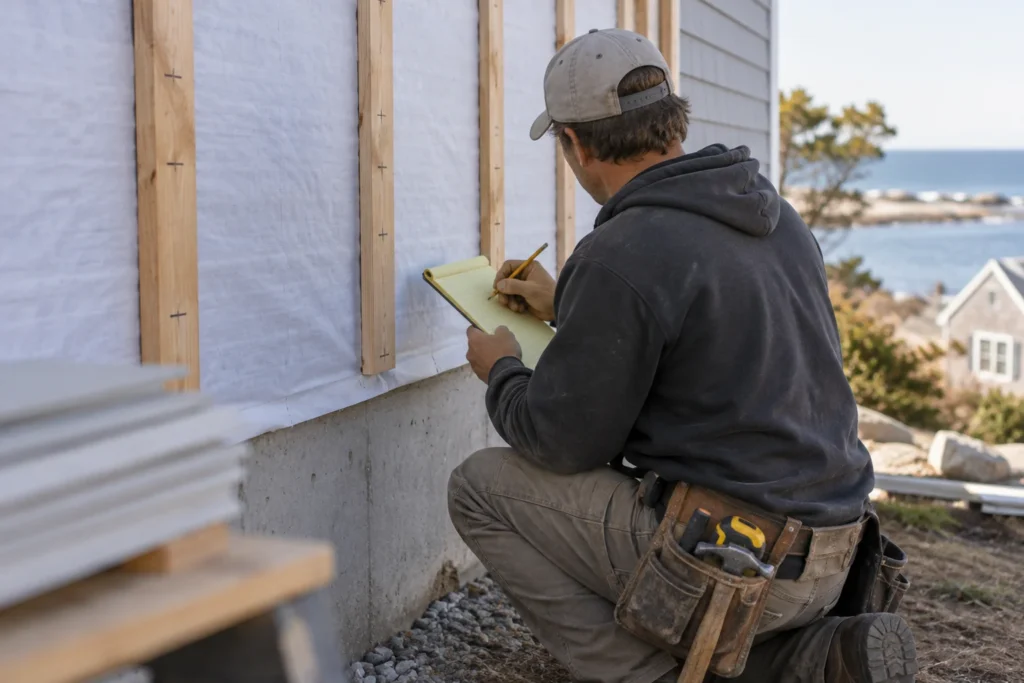
Contractor kneeling at a wall and noting stud locations on a yellow legal pad. Illustrative image.

Client Testimonials

Real clients. Their own words.

Hear directly from our clients about their experience working with Forty One Construction. Select a video to watch their story.

Forty One Construction · Client Stories Click to play · Sound on

Homeowner Reviews

What homeowners in Hyannis say

Forty One Construction holds a 5-star rating across 51 Google reviews.

5.0 ★★★★★ Google Reviews
★★★★★ Google
“From the first walkthrough to the final cleanup, their professionalism stood out. They explained every step clearly, offered smart recommendations…”
Brian Timmins Google review excerpt Google
★★★★★ Google
“We are enjoying our deck and patio and we love the fresh look our house now has.…”
Stephanie York Google review excerpt Google
★★★★★ Google
“Outstanding communication, craftsmanship, customer care and pricing. I would recommend them for any home improvement project, large or small.…”
RedBalloon Google review excerpt Google

Custom Decks · Cape Cod

Questions about siding installation on Cape Cod

Do you require a deposit, and how are payments tied to the siding project schedule?

Massachusetts consumer guidance advises homeowners not to pay more than one-third of the estimated cost upfront unless special-order materials are needed. Siding materials for a full re-side are often ordered before work begins, so we discuss how that affects the payment structure during the estimate. We tie payments to a written scope. Talk specifics with us before you sign anything.

Which siding brands do you install on Cape Cod homes?

We install vinyl from CertainTeed, Mastic, Royal Building Products, and Alside; fiber cement from James Hardie, including HardiePlank and HardieShingle; engineered wood from LP SmartSide; natural and engineered cedar; and PVC trim boards from AZEK and Versatex. House wrap is Tyvek or Typar. We spec the material to your home's exposure, the level of maintenance you want, and your budget.

Will siding installation disrupt daily life, and where will the crew stage materials on a tight coastal lot?

Most siding work happens on the exterior, so daily life inside is minimally affected. Our crew stages materials in one area and works around your schedule where we can. On tight Cape Cod lots, we plan staging before materials are delivered. During summer, Route 28 and Route 6 traffic can shift arrival times, and we account for that in scheduling.

What should I do to prepare before the siding crew arrives?

Usually not much. Move outdoor furniture, planters, or anything leaning against the exterior walls away from the house, and keep vehicles clear of the work area. If we find rot or water damage under the old siding during tear-off, we will call you before making repairs beyond what was scoped. We handle permits, layout, and cleanup. If we need anything specific from you, we say so at the consultation.

What if there is a problem with the siding installation after the job is finished?

Every install carries a 5-year workmanship warranty on labor and installation. Manufacturer warranties on siding and trim products are provided separately by the manufacturer. If something is not right with our work, call us. We come out and look at it at no charge, and if it is our error, we fix it at no cost to you.

Your siding estimate came in higher than another contractor's. Why should I choose Forty One Construction?

When two siding bids look similar on paper, the lower one wins by default. The gap usually sits in what you cannot see: stainless fasteners instead of galvanized, house wrap lapped and taped correctly, kick-out flashing at every roof-wall intersection, and a written scope that covers sheathing inspection. We are a licensed local contractor that pulls the permit in our name and stands behind the work.

Does re-siding a home in Hyannis require a building permit, and who handles that?

Yes, in most cases. Siding work in Hyannis is governed by the Town of Barnstable Building Division under 780 CMR, the Massachusetts State Building Code. We prepare the drawings, submit the application, and pull the permit in our name, then install to pass inspection. Permit fees are typically passed through as a line item in the quote.

When is the best time of year to schedule a siding installation on Cape Cod?

The exterior season runs roughly April through November. Freeze-thaw from November through March rules out work that depends on caulk and house wrap tape curing properly in cold, wet conditions. Many homeowners book in the shoulder seasons, spring and fall, to avoid peak summer occupancy and the permit and scheduling pressure that comes with it. Planning ahead by several weeks gives the most scheduling flexibility.

Free On-Site Estimate

Get a Quote

Ready to talk through your project? Forty One Construction will come out, look at your yard, and give you a written scope tied to real materials and a real number. Every install carries a 5-year workmanship warranty on labor and installation, with manufacturer warranties on materials provided separately by the manufacturer.

Our crew builds across Hyannis and Cape Cod, and our office is at 76 W Main St Unit 306, Hyannis, MA 02601. Call us or request an estimate and we'll get you on the calendar honestly, weather and permits accounted for.

Free Estimate
Owner-Led Service
Serving Cape Cod

No-pressure consultation · Clear upfront pricing