Siding repair on Cape Cod

Siding repair is the removal of damaged exterior cladding and the restoration of the wall section beneath it: pulling failed panels or boards, inspecting the sheathing and house wrap underneath, correcting any hidden rot or moisture damage, and installing new matching siding with proper flashing and fastening.

It is the right call when storm damage, rot, or impact has opened the wall to water, or when a section of siding has failed while the rest of the house is still sound. On Cape Cod the details decide how long a repair holds: wind-driven rain arrives sideways off the water and gets in at flashing seams, not the middle of a panel, and salt air corrodes the wrong fasteners within a season or two.

Daniel Araujo holds a Massachusetts Construction Supervisor License (CSL), Unrestricted (#CS-123114), and Forty One Construction is a BBB Accredited Business. We carry 51 Google reviews at 5 stars.

This page covers what a siding repair includes, what it costs in 2026 on the Cape, how the main siding materials compare in a coastal climate, and what the wall assembly under the panels actually requires to shed water.

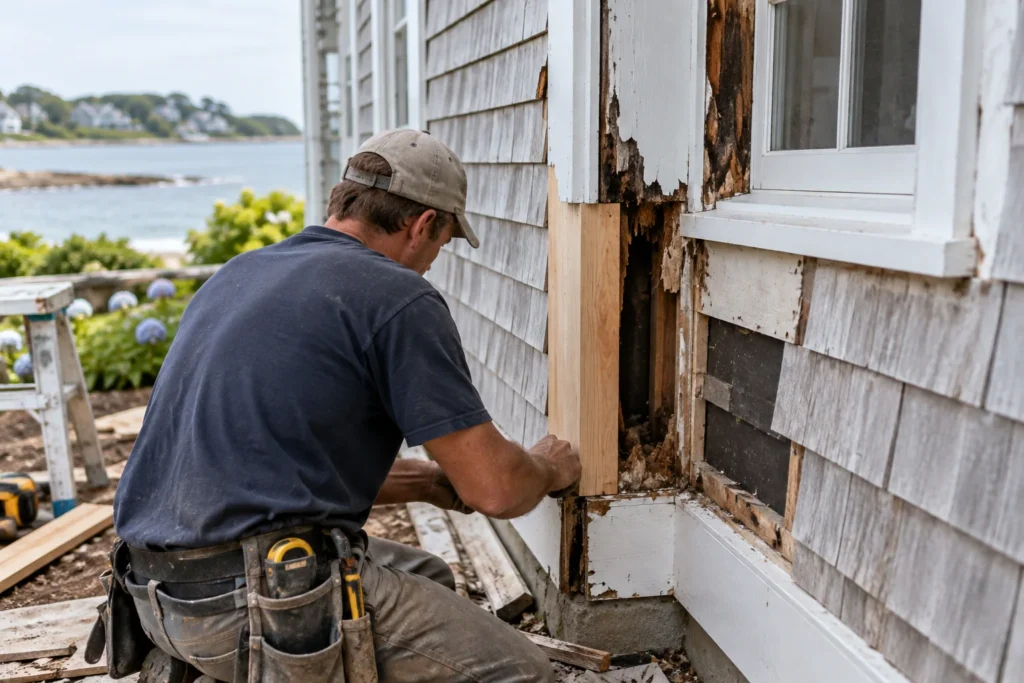
A carpenter nailing cedar shingles onto a weathered Cape Cod cottage exterior wall. Illustrative image.

Massachusetts License

CS-123114

MA CSL · Unrestricted

Home Improvement

217279

MA HIC Registration

Accreditation

BBB

Accredited Business

Google Reviews

5 Stars

51 Google Reviews

Project Planning

Free

On-Site Estimates

Before You Start · Cape Cod

How do I know if my siding needs repair rather than a full replacement?

If the damage is confined to a section or a few panels, repair is the right move. When failure is spread across most elevations or the substrate is compromised behind most of the wall, replacement is the honest answer. Repair the sound, replace what is not.

  • Bubbling or warped panels. Siding that has bowed, buckled, or lifted away from the wall is letting water behind it. The panel you see is rarely the only problem.
  • Rust stains on the wall face. Streaks bleeding down from fastener locations mean the nails or screws are corroding. Salt air does that to anything not stainless or hot-dip galvanized.
  • Soft wall behind the siding. If pressing near a seam or trim board produces any give, the sheathing beneath is wet. That is a rot problem, not a surface problem, and it needs to be opened up.
  • Caulk that has failed at joints or trim. Open seams at windows, corners, or butt joints let wind-driven rain straight into the wall cavity. It does not fall back out.
  • Paint peeling from inside out. Finish that fails from the substrate outward, rather than from weathering, usually means moisture is moving through the wall and condensing behind the paint film.
  • Cracked or missing sections after a storm. Impact or wind damage that breaks the panel lock lets water in at every rain event until it is corrected.

The one you cannot see matters most. Water that gets behind siding at a poorly lapped house wrap seam or an unflushed kick-out flashing can rot sheathing and framing long before any surface stain appears. If you have had a leak near an exterior wall, the siding is worth opening up to check.

Siding Repair · Cape Cod

What a siding repair includes from first inspection to final walkthrough

A siding repair with Forty One Construction runs through seven phases, from the first on-site damage assessment to the final weather-tightness check in Hyannis. Every phase has a clear purpose, and you get a written scope before any material is ordered or removed. Here is what each one covers.
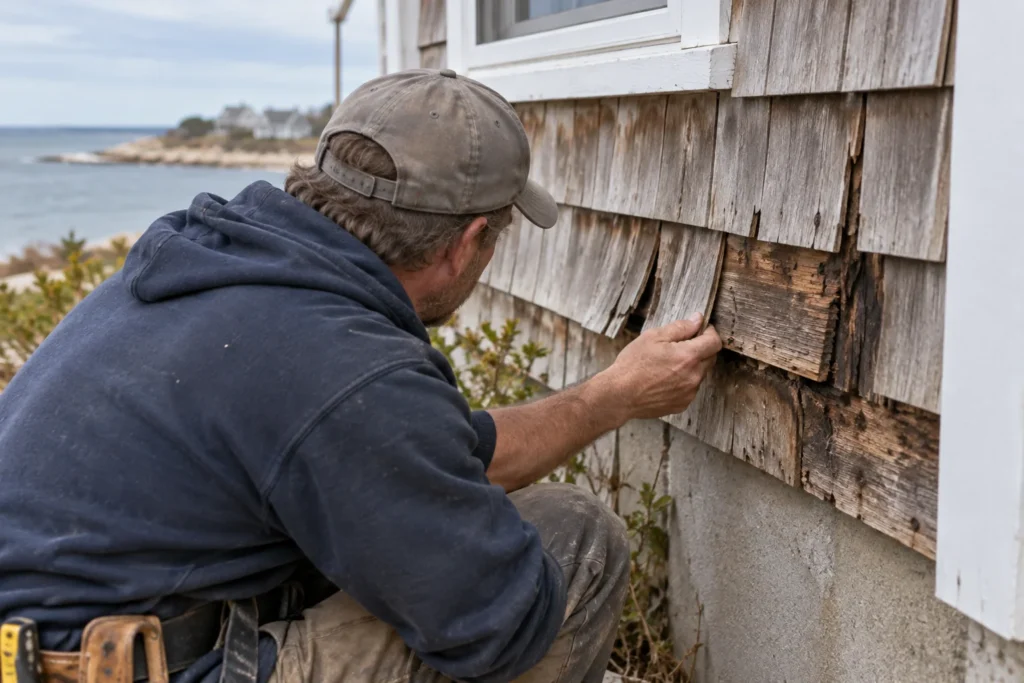
A worker closely examining cracked and rotted siding boards before removal begins. Illustrative image.

Assessment · Phase One

Assessing the damage before any siding comes off

01

Inspection and moisture check

We come to the house and look at the damaged section and the wall around it. We check for moisture in the sheathing, probe for soft spots, and note what is behind the siding before writing a scope. You get a written estimate that identifies the repair extent and the material match needed.

02

Scope and material match

We identify the siding profile, exposure, and color needed to match the existing wall. For older or discontinued products, that may mean sourcing a close match or adjusting the repair boundary so the blend is not visible. The written scope spells out exactly what is included before work begins.

A tradesman prying off damaged lap siding and inspecting the wet sheathing beneath. Illustrative image.

Repair Work · Phase Two

Removing damage and correcting what is underneath

03

Careful removal of damaged material

Our crew removes the failed siding sections without disturbing adjacent sound panels or boards. We work back to solid substrate, note what we find underneath, and flag anything that changes the scope before closing the wall. Nothing gets covered up without your sign-off.

04

Sheathing and house wrap

Any rotted sheathing is cut back to sound material and replaced. House wrap is lapped shingle-style so water sheds out rather than in. Kick-out flashing and any failed step flashing at transitions are corrected at this stage, before new siding goes on. Wind-driven rain on the coast finds every shortcut here.

05

New siding installation

New matching panels or boards go in with the correct fastening pattern and reveal. Vinyl is hung with room to move through a thermal cycle, not nailed tight. Cedar and fiber cement get corrosion-resistant fasteners, stainless or hot-dip galvanized, so nothing bleeds rust down the wall within a season or two.

A carpenter carefully caulking and painting the edges of freshly installed siding boards. Illustrative image.

Finish · Phase Three

Finishing the details and completing the repair

06

Caulking and trim

Caulk goes only at manufacturer-approved joints, not around every panel perimeter. Trim is reinstalled or replaced where it was disturbed, and any color-match finish work on the repaired section is completed so the repair blends with the surrounding wall.

07

Final walkthrough and weather check

We inspect the finished section for weather-tightness, confirm the coursing and reveal match the surrounding siding, and walk the repair with you. We do not call it done until you agree it looks right and the wall is sealed.

Scope · What You Are Buying

What your siding repair quote covers, and what it does not

A siding repair quote from Forty One Construction covers the damage assessment, removal and disposal of failed material, minor sheathing and house wrap repair, new matching siding installation, flashing and caulking, and cleanup. Full wall re-siding, structural framing repair, asbestos or lead paint abatement, insulation upgrades, and painting of full elevations beyond the repaired section are quoted separately.

Included in the quote

  • Damage assessment and moisture check
  • Written scope and material match identification
  • Removal and disposal of damaged siding material
  • House wrap, flashing, and sheathing repair where needed
  • New matching siding installation with correct fastening
  • Caulking, trim reinstallation, and color-match finishing
  • Pest or moisture remediation if uncovered during removal

Not included, quoted separately

  • Full wall or whole-house re-siding
  • Structural framing repair beyond sheathing
  • Asbestos or lead paint abatement
  • Insulation upgrades behind the wall
  • Painting of full elevations beyond the repaired section

Done correctly means sheathing moisture is below roughly 15 to 19 percent before the wall is closed, house wrap is lapped to shed water shingle-style, fasteners are corrosion-resistant for coastal exposure, vinyl panels are hung to allow thermal movement rather than nailed tight, and caulk is applied only at manufacturer-approved joints. Those are not preferences. They are what keeps wind-driven coastal rain out of the wall cavity for years after the repair.

A homeowner and contractor standing beside a repaired siding section discussing final costs. Illustrative image.

Repair Cost · Cape Cod

How much does siding repair cost on Cape Cod?

Siding repair on Cape Cod typically runs $4 to $16 per square foot installed in 2026, with small patch jobs averaging $200 to $1,000 or more. Forty One Construction quotes each repair in Hyannis after an on-site visit, because the extent of hidden rot or sheathing damage is not visible until the panels come off.

Most single-section repairs fall well below a full re-siding project in total cost.

$30–$75 Per square foot installed
$10K–$20K Typical patch job range

Cost Factors

What moves the price

The price moves with a handful of real drivers, including siding material type, damage extent, story height, profile availability, and what is found under the panels during removal.

01

Siding material type

Vinyl costs less per square foot to replace than fiber cement or cedar clapboard.

02

Damage depth and extent

Surface-only panel damage costs less than repairs that also require sheathing or framing correction underneath.

03

Story height and staging

A second-floor repair that needs staging or ladder work takes longer and costs more than the same repair at grade.

04

Profile age and sourcing

Discontinued or older profiles may require extra sourcing time or a wider repair boundary to achieve a clean color and profile match.

05

Hidden damage found on removal

Rot in the sheathing or framing discovered after panels come off changes the scope and the price.

2026 Cost Guide

Typical repair cost by scope

These ranges are a starting point for planning. Every repair is quoted after an on-site assessment.

Job size / scope Typical range on Cape Cod (2026)
Spot repair (1 to 3 panels or boards) $200 to $1,000 or more
Section repair (one wall area or storm damage zone) $4 to $16 per sq ft installed; varies with material and depth
Repair with sheathing or house wrap replacement Higher end; depends on extent of hidden damage found

A minimum trip or service call charge may apply to small jobs. Every repair is quoted after an on-site assessment.

Get a Free Estimate →

Siding Materials · Cape Cod

Vinyl, fiber cement, or cedar: which siding material holds up in a coastal climate?

The right replacement material depends on your budget and your tolerance for maintenance, but within a few miles of salt water, and on Cape Cod nearly every house qualifies, the fasteners matter as much as the panels. Below are the main materials we work with, honestly compared. Whatever the cladding, we use stainless or hot-dip galvanized fasteners so nothing bleeds rust down your repaired wall.
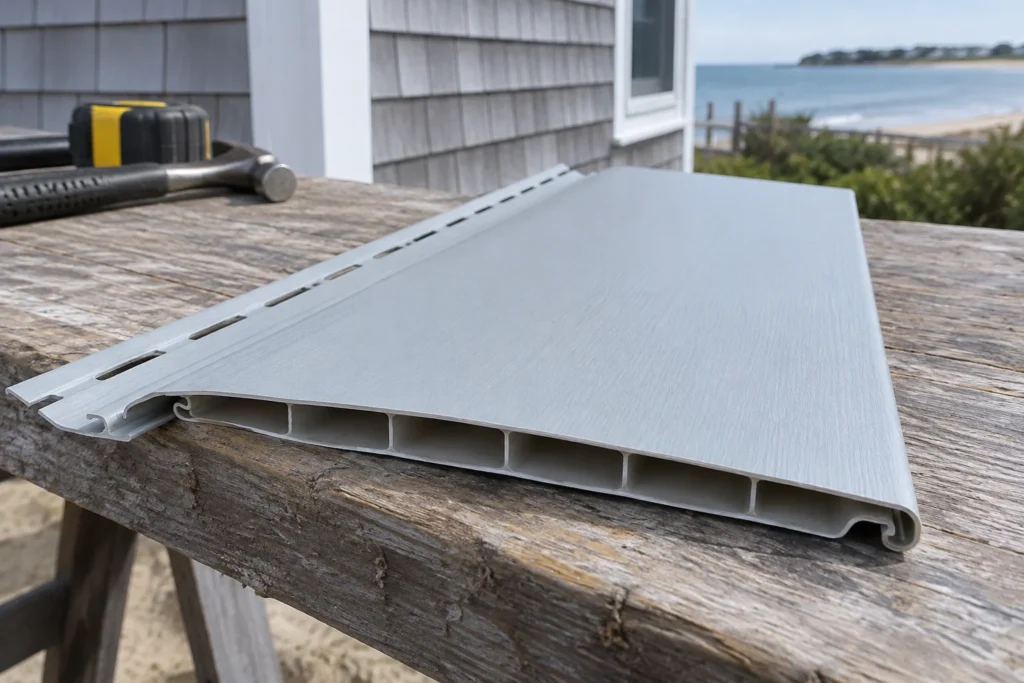
A single vinyl siding panel laid flat showing the hollow back and smooth painted face. Illustrative image.

Vinyl · Entry Tier

Vinyl siding

The lowest-cost option and the most common on the Cape. It resists rot and salt air well and needs no painting. Best for homeowners who want a low-maintenance material at a reasonable cost. Panels must be hung with room for thermal movement, not nailed tight, or they buckle in summer heat.
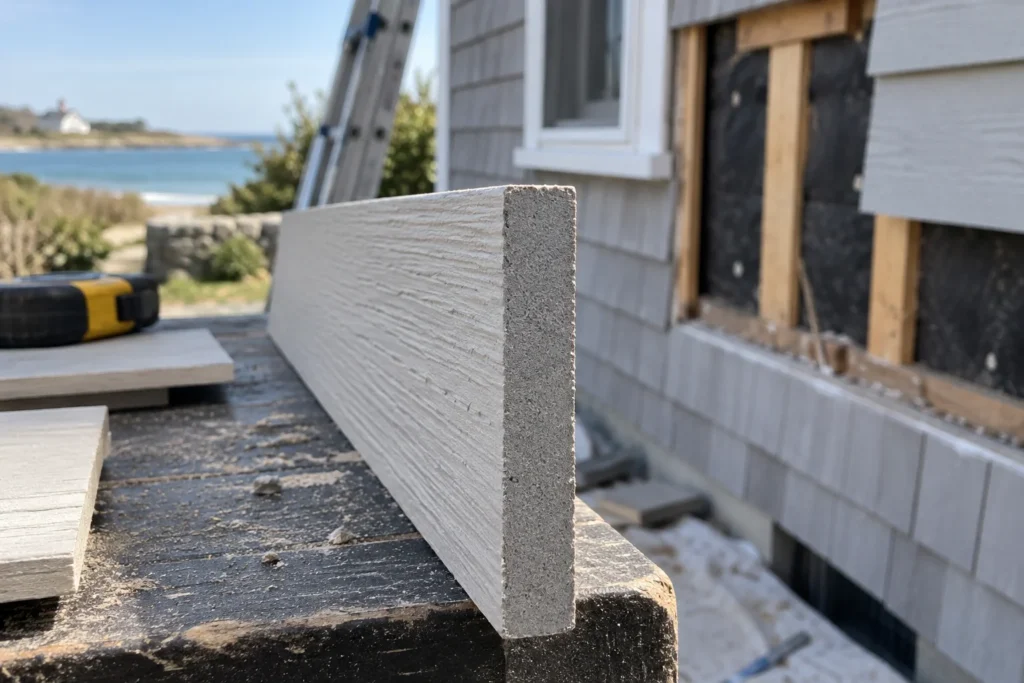
A cut fiber cement plank standing on edge revealing the dense solid gray core. Illustrative image.

Fiber Cement · Coastal Workhorse

Fiber cement

James Hardie HardiePlank and similar products are dimensionally stable, resist moisture, and hold paint well in salt air. Best for homeowners who want the look of painted wood without the rot risk. It requires corrosion-resistant fasteners and correct clearances from grade and roofing to perform as intended.

A cedar clapboard sample held at an angle showing the tapered cut edge and raw wood grain. Illustrative image.

Wood · Regional Classic

Cedar clapboard

Clear or number-one grade cedar is a regional standard on the Cape and naturally resistant to rot. It weathers to a soft gray if left alone or holds color with paint or stain. Best for homeowners who want a traditional New England appearance. Galvanized fasteners will stain cedar within a season or two; we use stainless only.
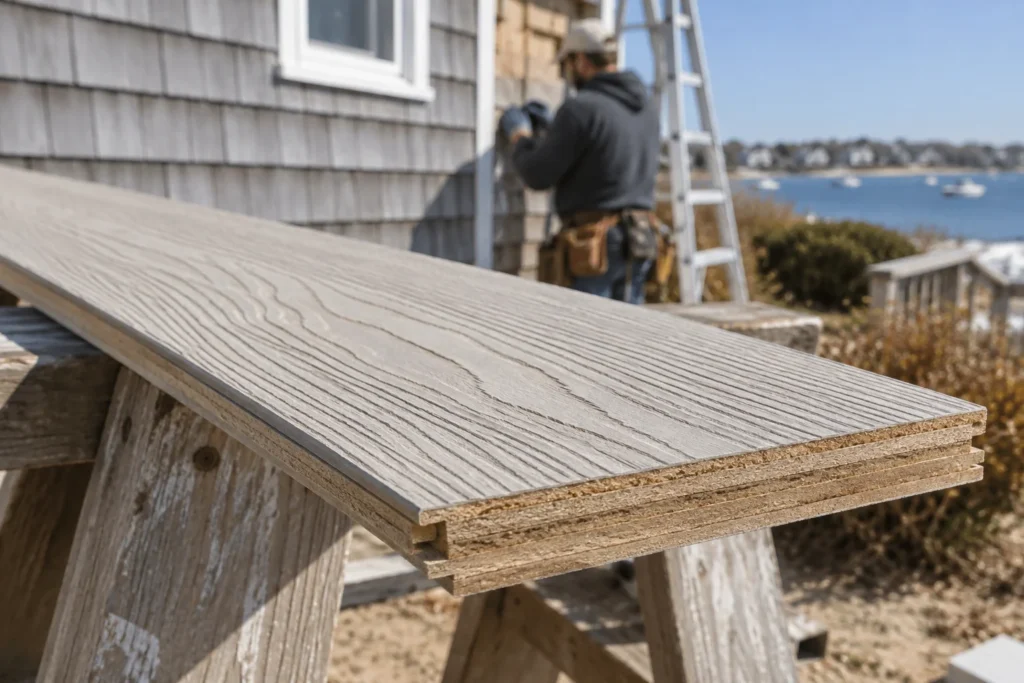
An engineered wood plank laid flat showing the embossed wood-grain surface and layered compressed core. Illustrative image.

Engineered Wood · Mid-Range

Engineered wood

LP SmartSide and similar products combine a wood-fiber core with a resin-treated overlay that resists moisture and impact better than plain wood. Best for homeowners who want a paintable wood appearance with better dimensional stability than cedar. Requires sealed cut ends and correct installation clearances, especially in coastal conditions.
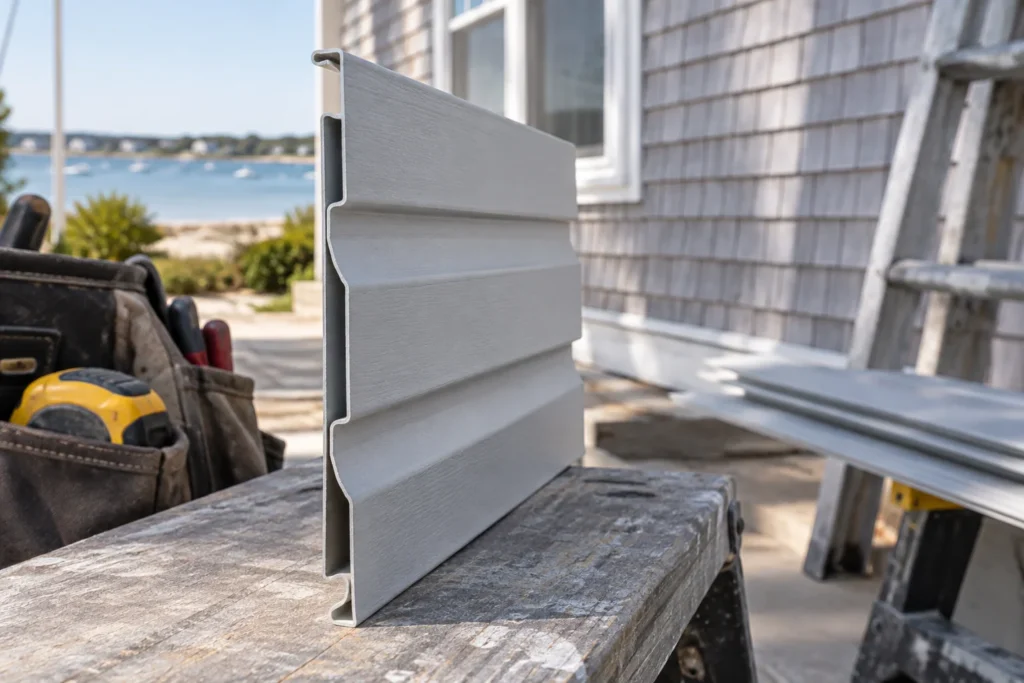
A short aluminum siding panel standing upright showing the thin metal profile and ribbed face. Illustrative image.

Aluminum · Repair Stock

Aluminum siding

Standard mill-finish or painted aluminum replacement stock is still common on older Cape Cod homes. It does not rot and holds up to salt air, but it dents and the paint finish can chalk over time. Best when matching an existing aluminum installation where changing material type is not practical or cost-effective.

Material Comparison

Compare siding repair materials

Compare where each material fits best, how it performs against Cape Cod salt air and wind-driven rain, and the level of maintenance it requires.

Option Best for Holds up to salt air Maintenance
Vinyl Low cost, low upkeep Good (no sealing needed) Low
Fiber cement Painted wood look Very good with proper fasteners Medium (repainting)
Cedar clapboard Traditional appearance Good with stainless fasteners Medium to high
Engineered wood Wood look, better stability Good with sealed ends Medium
Aluminum Matching older installations Very good Low to medium

We name real brands when we spec a repair job: James Hardie and Nichiha for fiber cement, CertainTeed, Royal Building Products, and Mastic for vinyl, LP SmartSide for engineered wood, and clear or number-one cedar for wood. If a less expensive material is the right match for your wall, we will tell you.

A crew efficiently replacing a section of blown-off siding on a tight deadline. Illustrative image.

Repair Timeline · Cape Cod

How long does a siding repair take on Cape Cod?

A siding repair with Forty One Construction takes anywhere from a few hours to half a day for a spot repair of one to three panels, one full day for a moderate section repair covering a storm-damaged wall area, and one to three days for repairs that involve sheathing or house wrap replacement, depending on the extent of hidden damage found once the wall is opened.

Two things can stretch that window here. Summer is the hardest time to book on the Cape, with seasonal homeowners scheduling exterior work between Memorial Day and Labor Day when crews are in highest demand. And repairs that uncover unexpected rot in the sheathing or framing change scope mid-job, which is why we do a moisture assessment before writing the estimate rather than discovering it after panels are removed.

3–5 days Spot repair, 1 to 3 panels
1–2 weeks Section repair, one wall area
3–5 weeks Repair with sheathing replacement
A worker stapling new housewrap over exposed sheathing before installing replacement siding boards. Illustrative image.

Wall Assembly · Cape Cod

What the wall assembly behind Cape Cod siding actually requires

The wall assembly is everything behind the panels: sheathing, house wrap, and flashing. It is where a siding repair is made durable or made to fail again. On Cape Cod, two details decide whether a repair holds: how the house wrap is lapped and flashed at transitions, and whether water has already reached the sheathing before the panels came off.

House Wrap

House wrap and water-resistive barrier

The house wrap or water-resistive barrier is the layer that sheds water when wind-driven rain gets past the siding, and on the Cape it always does eventually. It has to be lapped shingle-style, upper layer over lower, at every seam and transition, so water that gets behind a panel runs out rather than in. A house wrap that is cut, torn, or lapped the wrong way at a repair boundary does the same job as no house wrap at all. We read moisture levels in the sheathing before closing any wall section, and we do not close it until readings are in a safe range.

Flashing Details

Kick-out flashing and transition details

Kick-out flashing diverts water away from the wall at roof-to-wall intersections, and it is one of the most commonly skipped details in exterior repair work. Wind-driven rain on the coast arrives sideways and loads these transitions hard. We install or correct kick-out flashing, step flashing, and J-channel details as part of any repair where those transitions fall within the work area. Fasteners throughout are corrosion-resistant: stainless or hot-dip galvanized, because airborne salt degrades standard hardware within a season or two in this climate, and the fastener is what holds the panel to the wall.

Service Life · Coastal Exposure

How long does a siding repair hold up on Cape Cod?

The wall assembly decides it, not the panel. A repair done over dry sheathing, with correctly lapped house wrap, proper flashing, and corrosion-resistant fasteners, holds up far longer than one that closes over a moisture problem. We do not publish a single lifespan figure, because the honest answer depends on the material, the exposure, and whether the underlying conditions were corrected, and a number that ignores all three is not useful.

  • Salt air attacks fasteners first. The whole service area sits within a few miles of salt water. Standard galvanized nails bleed rust down cedar and other siding within a season or two. Stainless or hot-dip galvanized fasteners do not.
  • Wind-driven rain finds open joints. Rain on the Cape arrives sideways, and it loads every unsealed butt joint, failed caulk line, and unlapped house wrap seam. Water gets behind siding at the details, not the middle of the panel.
  • Freeze-thaw splits unsealed cut ends. Water that gets into an open end grain joint freezes, expands, and cracks the material, roughly November through March every year.
  • Keeping it sealed extends it. Check caulk at windows and trim annually, keep vegetation clear of the siding face, and have any new staining or soft spots looked at before they grow into a larger rot repair.

Forty One Construction backs labor and installation with a 5-year workmanship warranty. Manufacturer warranties on siding materials are provided separately by the manufacturer and vary by product.

Local Siding Repair · Cape Cod

Where we do siding repair across Cape Cod and the South Shore

Forty One Construction handles siding repair across Cape Cod from our office in Hyannis, and the coastal conditions shape every job. Salt air corrodes the wrong fasteners within a season or two, wind-driven rain loads every detail at windows and trim transitions, and freeze-thaw from November through March finds every unsealed cut end or open joint. A repair built for inland Massachusetts is not built for this coast.

We serve homeowners from the outer Cape through the canal: Provincetown, Truro, Wellfleet, Eastham, Orleans, Chatham, Brewster, Harwich, Dennis, and Yarmouth on one side, and Hyannis, Centerville, Osterville, Cotuit, Mashpee, Falmouth, Bourne, Sagamore, Sandwich, and Barnstable through the mid- and upper Cape, along with Plymouth. See our work in Hyannis and Barnstable.
Hyannis Home Base
Cape Cod Local Coverage
Plymouth South Shore
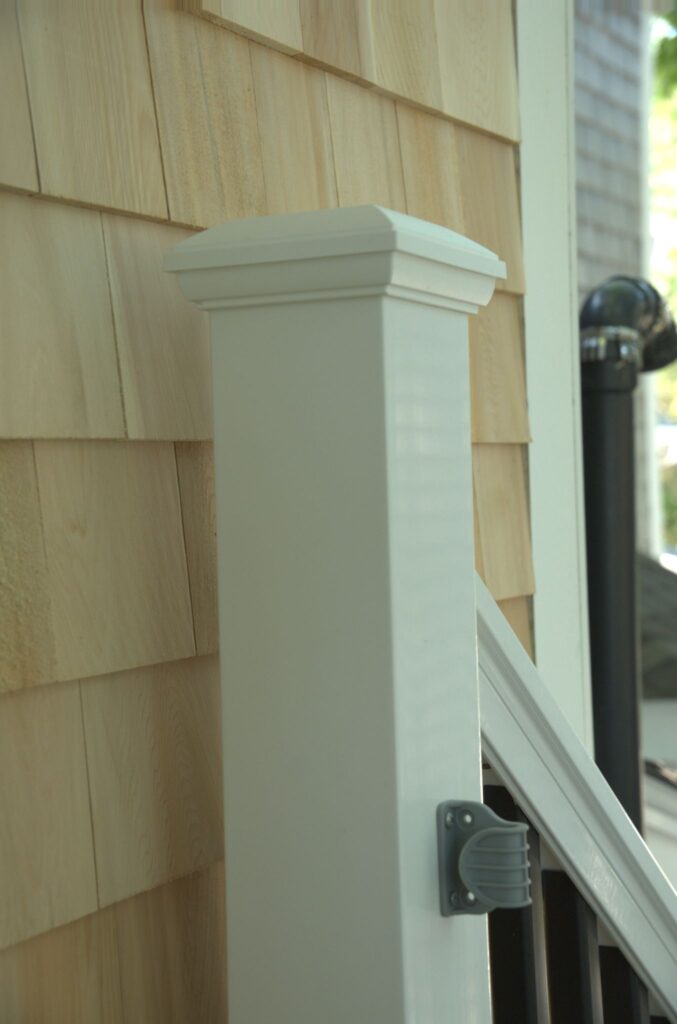
White newel post and cap set against natural cedar shake siding, a Forty One Construction project on Cape Cod

Credentials · Accountability

What to verify before your project starts

Credentials

License and coverage you can verify

Daniel Araujo holds a Massachusetts Construction Supervisor License (CSL), Unrestricted (#CS-123114), and the company holds Home Improvement Contractor registration #217279. We carry $1,000,000/$2,000,000 general liability coverage, and a certificate of insurance is available on request. The numbers are printed so you can check them. Learn more about us.

Permits · Code

We pull the permit and build to code

We submit drawings to the Town of Barnstable Building Division and pull the permit in our name. Footings reach frost depth, ledgers get through-bolted and flashed, and every connection is built to pass framing and final inspection, not just to look finished.

Before Construction

A written scope before we order a board

You get a written scope up front, so the number in your hand is tied to specific materials and work, not a vague figure that grows halfway through. When quotes look interchangeable on paper, that's usually where the real difference sits.

A carpenter measuring a damaged siding section carefully before cutting any replacement boards. Illustrative image.

Client Testimonials

Real clients. Their own words.

Hear directly from our clients about their experience working with Forty One Construction. Select a video to watch their story.

Forty One Construction · Client Stories Click to play · Sound on

Homeowner Reviews

What homeowners in Hyannis say

Forty One Construction holds a 5-star rating across 51 Google reviews.

5.0 ★★★★★ Google Reviews
★★★★★ Google
“From the first walkthrough to the final cleanup, their professionalism stood out. They explained every step clearly, offered smart recommendations…”
Brian Timmins Google review excerpt Google
★★★★★ Google
“We are enjoying our deck and patio and we love the fresh look our house now has.…”
Stephanie York Google review excerpt Google
★★★★★ Google
“Outstanding communication, craftsmanship, customer care and pricing. I would recommend them for any home improvement project, large or small.…”
RedBalloon Google review excerpt Google

Custom Decks · Cape Cod

Questions about siding repair on Cape Cod

Do you require a deposit, and how are payments structured for a siding repair job?

Massachusetts consumer guidance advises homeowners not to pay more than one-third of the estimated cost upfront unless special-order materials are needed. We work within that standard and tie payments to a written scope. Talk specifics with us before you sign anything.

Which siding brands and materials can you match for a repair on an existing Cape Cod home?

We work with vinyl from CertainTeed, Royal Building Products, and Mastic; fiber cement from James Hardie and Nichiha; cedar clapboard in clear or number-one grade; engineered wood such as LP SmartSide; and aluminum replacement stock. For older or discontinued profiles, we source the closest available match or adjust the repair boundary so the blend is not visible.

Will the siding repair disrupt daily life inside the house, and where does the crew stage materials?

Siding repair happens on the exterior wall, so daily life inside is barely affected. The crew stages removed material and new panels in one area near the work zone. In summer, Route 28 and Route 6 traffic can shift arrival times, and we account for that in scheduling rather than promising a start time we cannot hold.

What should I do to prepare before the crew arrives for a siding repair?

Clear any furniture, planters, or equipment away from the exterior wall being repaired, and move vehicles out of the immediate work area. We handle the inspection, material sourcing, removal, and cleanup. If we need anything specific from you, we will say so when we write the scope.

What happens if the repair uncovers rot or moisture damage in the sheathing behind the siding?

We stop and tell you what we found before closing the wall. Rotted sheathing is cut back to sound material and replaced, and any failed house wrap or flashing is corrected at the same time. The updated scope and any cost change are agreed in writing before we proceed. Labor and installation are backed by a 5-year workmanship warranty; manufacturer warranties on materials are provided separately by the manufacturer.

Another contractor quoted less for the same siding repair. Why would I choose Forty One Construction?

When two quotes look similar on paper, the lower one wins by default. The gap usually sits in what is not written down: stainless fasteners instead of galvanized, house wrap lapped correctly at seams, sheathing moisture checked before the wall is closed, and a written scope that names what is and is not included. We are a licensed local contractor who stands behind the work with a written warranty.

Does siding repair in Hyannis require a building permit, and who handles that?

Minor spot repairs typically do not require a permit, but section replacements or repairs involving sheathing and structural work may fall under the Town of Barnstable Building Division review under 780 CMR, the Massachusetts State Building Code. We assess permit requirements as part of the scoping process and handle any required submissions in our name.

When is the best time of year to schedule siding repair on Cape Cod?

Exterior repair runs best from April through November, when temperatures stay above the threshold needed for caulk and paint to cure properly. Freeze-thaw from roughly November through March rules out work that depends on dry time. Summer fills fast as seasonal homeowners schedule exterior projects, so booking in spring or early fall gives the most scheduling flexibility.

Free On-Site Estimate

Get a Quote

Ready to talk through your project? Forty One Construction will come out, look at your yard, and give you a written scope tied to real materials and a real number. Every install carries a 5-year workmanship warranty on labor and installation, with manufacturer warranties on materials provided separately by the manufacturer.

Our crew builds across Hyannis and Cape Cod, and our office is at 76 W Main St Unit 306, Hyannis, MA 02601. Call us or request an estimate and we'll get you on the calendar honestly, weather and permits accounted for.

Free Estimate
Owner-Led Service
Serving Cape Cod

No-pressure consultation · Clear upfront pricing