Massachusetts License
CS-123114
MA CSL · Unrestricted

Siding replacement is the full removal of your home's existing exterior cladding down to the sheathing, followed by installation of a new weather-resistive barrier, flashing at every penetration, and new siding and trim in the material you choose.
It is the right call when existing siding has failed, when rot or moisture damage has reached the sheathing, or when the house needs a fully weatherproofed exterior envelope. On Cape Cod, the details decide how long it lasts: salt air corrodes the wrong fasteners, wind-driven rain gets behind siding at the flashing joints, and freeze-thaw splits any unsealed cut end left exposed through winter.
Daniel Araujo holds a Massachusetts Construction Supervisor License (CSL), Unrestricted (#CS-123114), and Forty One Construction is a BBB Accredited Business. We carry 51 Google reviews at 5 stars.
This page covers what a siding replacement includes, what it costs in 2026, how the cladding materials compare in a coastal climate, and what the flashing and WRB details on a Cape Cod re-side actually require.
Siding Replacement · Cape Cod
A siding replacement with Forty One Construction runs through seven phases, from the first on-site measurement to the final inspection and walkthrough in Hyannis. Every phase has a name, a purpose, and a point where you review the work before we move on. Here is what each one covers.

Planning · Phase One
We come to your home, measure the wall area, and inspect the existing cladding and trim. We note conditions at windows, doors, and roof-wall intersections, then provide a written scope with material options and pricing before anything is ordered.
We prepare the permit application and submit it to the Town of Barnstable Building Division, which governs the work under 780 CMR, the Massachusetts State Building Code. The permit is pulled in our name. That is how it should be: the contractor who installs it signs for it.
Installation · Phase Two
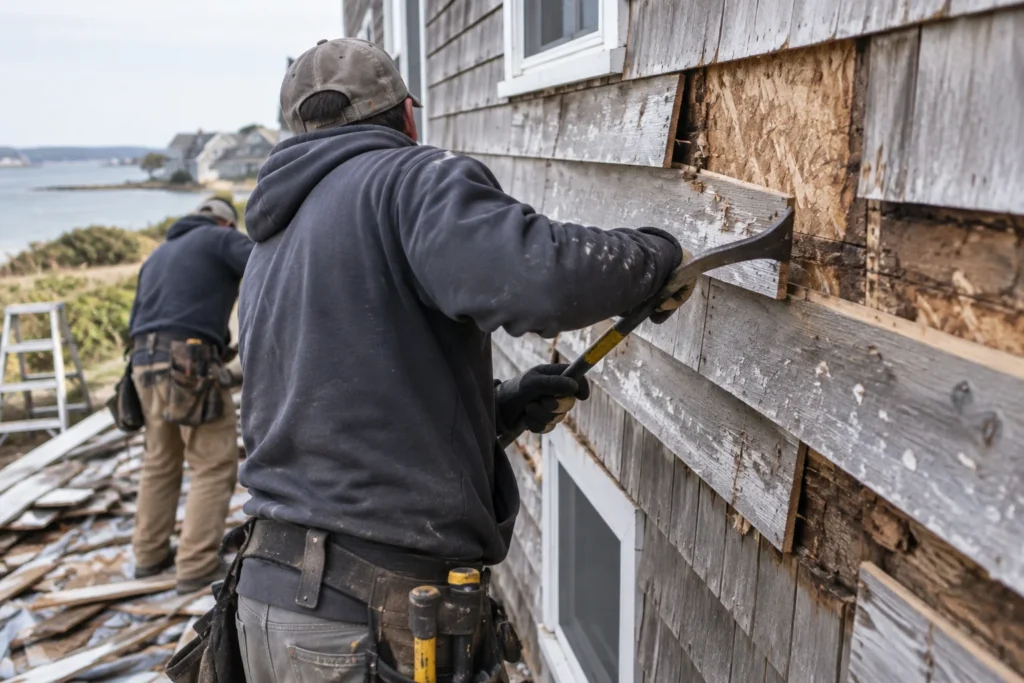
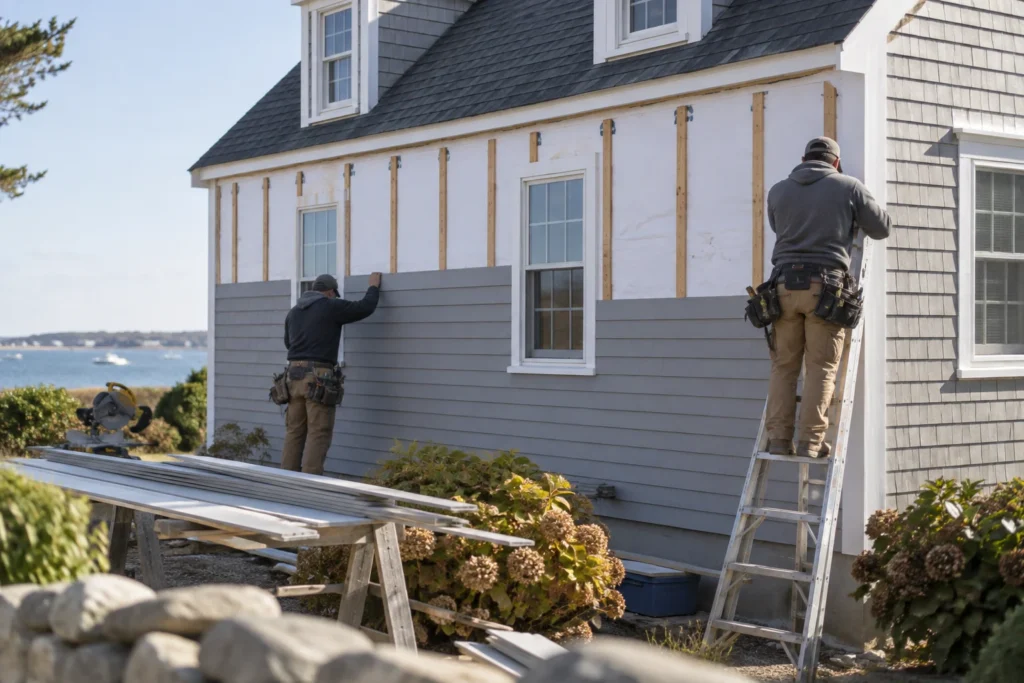
The crew removes existing siding, trim, and accessories down to the sheathing. Once exposed, sheathing is inspected for rot, moisture damage, and soft spots. Any damaged sections are repaired or replaced before the wall is closed back up.
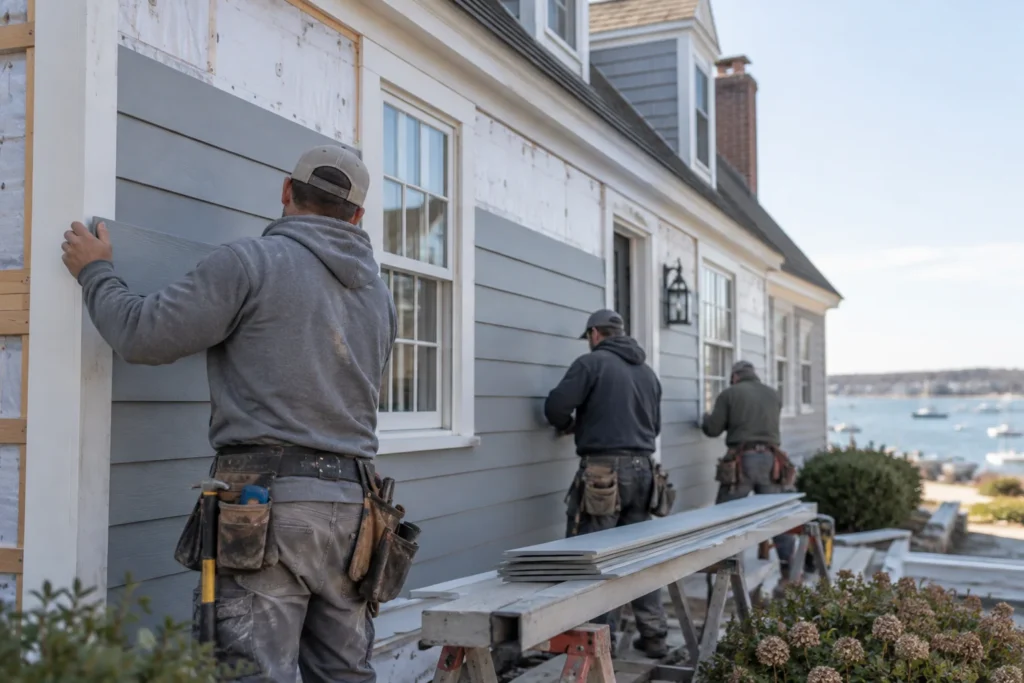
New house wrap is installed shingle-style, upper courses overlapping lower, with all seams taped. Flashing goes in at every window, door, roof-wall intersection, and penetration. On the Cape, wind-driven rain arrives sideways, so laps and kick-out details get real attention here.
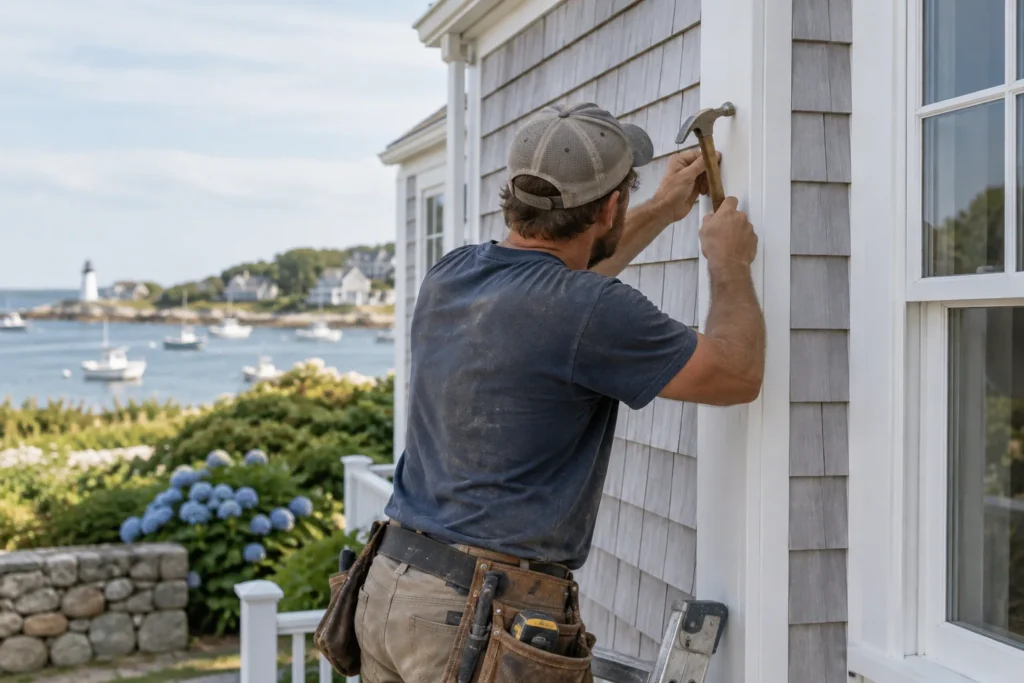
New cladding goes on per the manufacturer nailing schedule. Fasteners are coastal-grade, stainless or hot-dip galvanized, so nothing bleeds rust down new cedar or fiber cement within a season. Reveal, expansion gaps, and clearances from grade and roofline are set correctly.
Finish · Phase Three
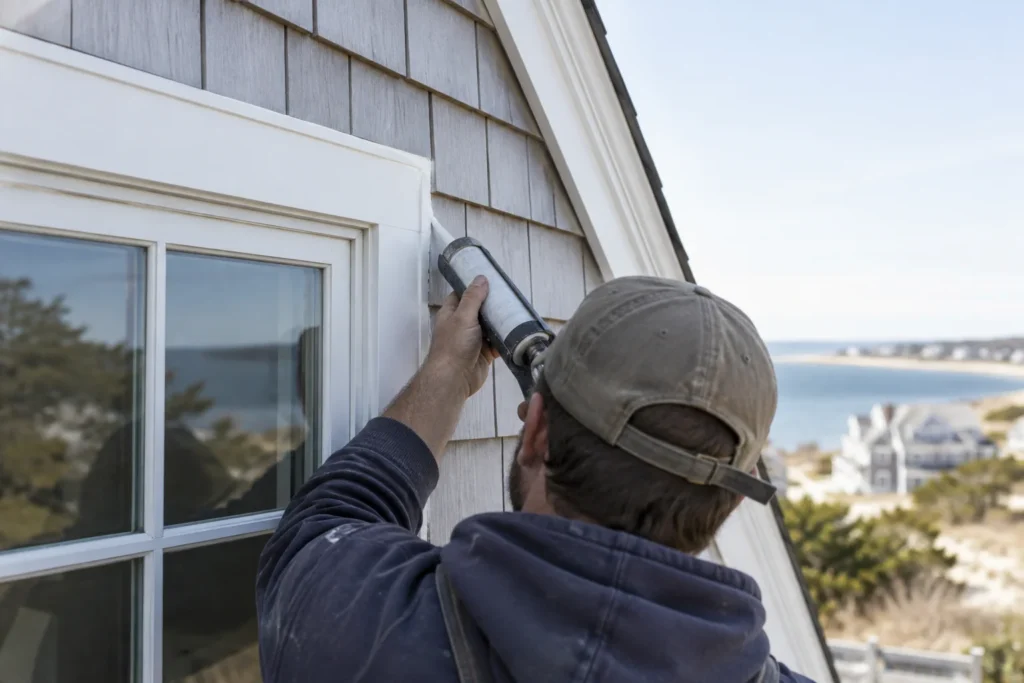
J-channel, starter strip, Z-flashing, corner trim, and all window and door surrounds go on after the field panels. Trim is finished to factory spec or primed for paint where specified. Caulk is applied to clean, dry surfaces only.
The building inspector signs off, we clean the site, and we walk the finished exterior with you. You see the work, ask questions, and we do not call it done until you agree it is.

Siding Cost · Cape Cod
Siding replacement on Cape Cod typically runs $8 to $22 per square foot installed in 2026, with Forty One Construction quoting each job in Hyannis after an on-site visit. Material choice and architectural complexity move the number most, with a typical single-family home falling between $15,000 and $45,000 or more.
A typical single-family home re-side often lands in our $15,000 to $45,000 project range.
Cost Factors
The price moves with a handful of real drivers, including material choice, total wall area, home complexity, sheathing condition found at tear-off, and coastal fastener requirements.
Vinyl costs least; fiber cement, engineered wood, cedar, and composite each step up in material and labor cost.
More square footage and additional stories mean more cladding, more scaffold or staging time, and more labor.
Dormers, gables, and intricate trim detail require more cuts, more flashing, and more time per square foot than a simple rectangle.
Rot or moisture damage found once the old cladding comes off adds material and labor that cannot be known until the wall is open.
Stainless and hot-dip galvanized hardware costs more than standard. A tight or elevated site adds staging time.
2026 Cost Guide
These ranges are a starting point for planning. Every job is quoted after an on-site assessment.
| Job size / scope | Typical range on Cape Cod (2026) |
|---|---|
| Single elevation or small section re-side | Lower end of $8-$22/sq ft installed |
| Full re-side on a typical 1,500-2,500 sq ft single-family home | Often lands in the $15,000-$45,000 project range |
| Larger or architecturally complex home with dormers and trim | Upper end; premium materials and hidden repair push higher |
Permit and inspection lead time factor in too. Every job is quoted after an on-site visit and measurement.
Get a Free Estimate →Siding Materials · Cape Cod
The right cladding depends on your budget and maintenance tolerance, but within a mile or two of salt water, and on Cape Cod nearly all of us are, the fasteners matter as much as the panels. Below are the material options we install, compared honestly. Whatever the cladding, we use stainless or hot-dip galvanized hardware so nothing bleeds rust down your new siding.

Vinyl · Entry Tier
The lowest-cost option and the most common on Cape Cod. Standard vinyl needs no painting and resists salt air well, but it requires expansion gaps sized for temperature swings. Insulated vinyl adds a foam backer for added wall R-value. Brands include CertainTeed, Mastic, and Royal.

Fiber Cement · Coastal Standard
James Hardie HardiePlank and HardieShingle are the most common fiber cement products we install. Fiber cement resists rot, holds paint well, and handles salt air without corroding. It is heavier than vinyl and requires more care at cuts: unsealed end grain will absorb moisture, so every cut end gets sealed before it goes on the wall.
Engineered Wood · Mid-Tier
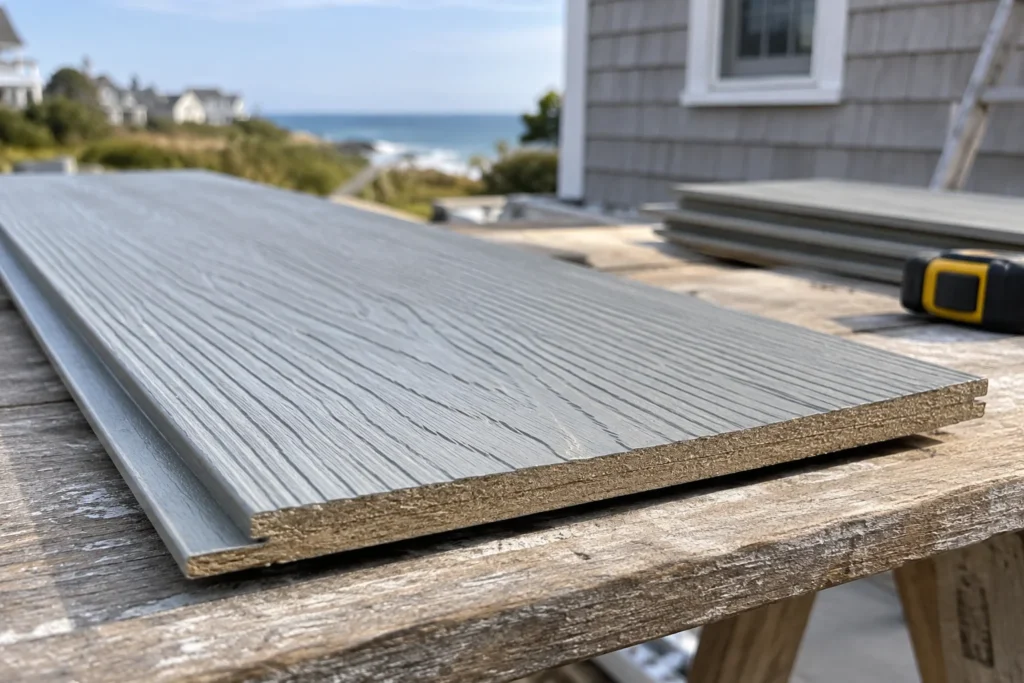
LP SmartSide uses a treated wood-strand core with a textured overlay. It machines and installs like wood, takes paint well, and performs better than natural wood in wet conditions. It needs the same attention to sealed end grain and proper clearance from grade that any wood-based product does in a coastal climate.
Cedar · Regional Classic
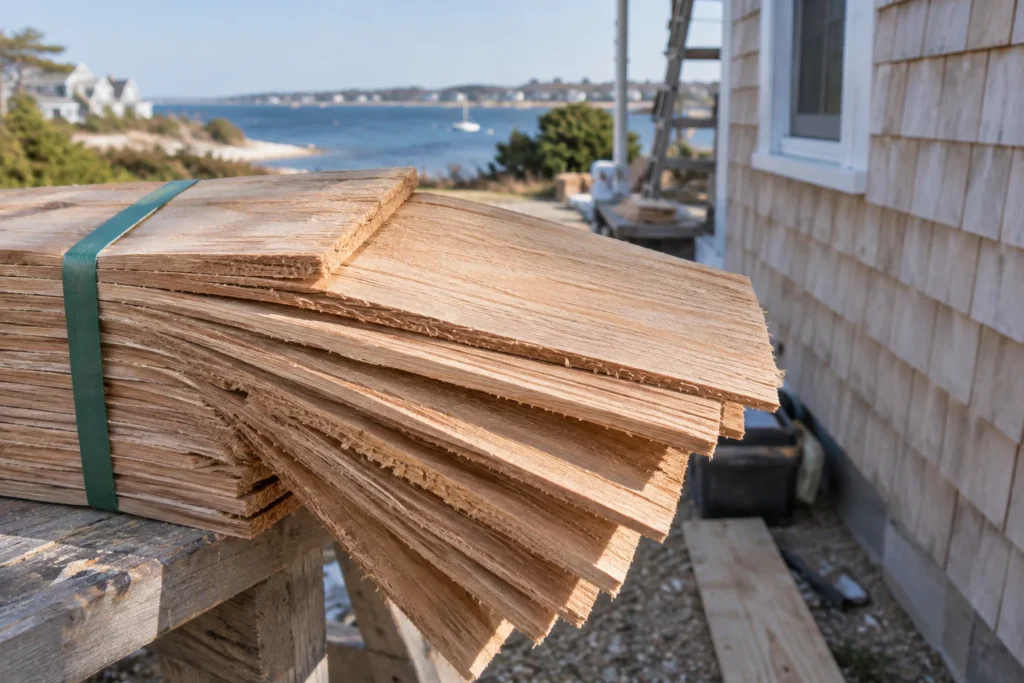
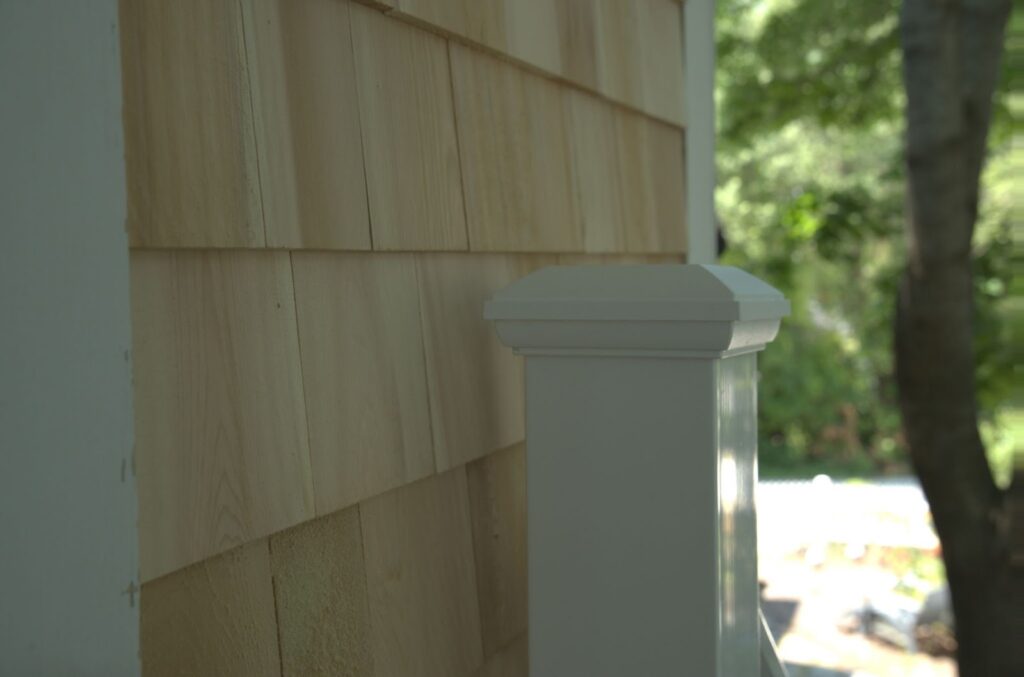
Atlantic White cedar shingles are a regional standard on Cape Cod and weather to a soft gray if left untreated. Cedar is naturally rot-resistant but needs stainless fasteners: galvanized nails bleed rust stains down new cedar within a season or two. SBC Cedar is one source we work with. End grain must be sealed before installation.

Composite · Low Maintenance
Composite and polymer panels replicate the look of cedar shakes without the maintenance burden. They resist rot, hold color without repainting, and handle salt air well. They cost more than vinyl up front and suit homeowners who want a wood appearance without the upkeep that comes with it on the coast.
Material Comparison
Compare where each material fits best, how it performs in Cape Cod salt air, and the level of maintenance it requires after installation.
| Option | Best for | Holds up to salt air | Maintenance |
|---|---|---|---|
| Vinyl (standard or insulated) | Tight budgets | Good (no metal to corrode) | Low |
| Fiber cement | Durability, paint hold | Very good with sealed end cuts | Low to medium |
| Engineered wood | Wood look, mid-tier cost | Good with sealed ends | Low to medium |
| White cedar shingles | Regional look, natural material | Good with stainless fasteners | Medium |
| Composite or polymer shake | Wood appearance, no upkeep | Very good | Very low |
We name real brands when we spec a job: fiber cement from James Hardie or Nichiha, vinyl from CertainTeed, Mastic, or Royal, and engineered wood such as LP SmartSide. If a less expensive material is the right fit for how the house is used and where it sits, we will tell you.
Project Timeline · Cape Cod
A siding replacement with Forty One Construction takes anywhere from 2 to 4 days for a small single-story home or a single elevation, 1 to 2 weeks for a typical 1,500 to 2,500 square foot single-family home, and 2 to 4 weeks for a larger or architecturally complex home with dormers, gables, and extensive trim, plus permit and material order lead time before work begins.
Three things stretch that window here. Permit review at the Town of Barnstable Building Division adds lead time before the first panel goes on. Weather closes exterior work: freeze-thaw from roughly November through March and nor'easters through the same stretch cost days, and wet or cold conditions affect WRB adhesion and caulk cure time. Hidden rot or sheathing damage found at tear-off adds repair days that cannot be scheduled in advance, and we build that possibility into an honest scope rather than promising a fixed date that ignores it.

Wall Assembly · Cape Cod
The wall assembly is everything behind the cladding: sheathing, house wrap, and flashing at every penetration. It is where a re-side is done right or done wrong. On Cape Cod, two details decide whether water stays out: how the WRB is lapped, and how every window, door, and roof-wall intersection is flashed. Get either wrong and water gets in at the joints, not through the middle of the panel.
The weather-resistive barrier is the drainage plane behind the siding. It has to be installed shingle-style, upper courses overlapping lower, with all horizontal and vertical seams taped, so water that gets behind the cladding has a path down and out rather than into the sheathing. On Cape Cod, wind-driven rain does not fall straight down. It arrives sideways off the water and finds any unsealed lap or untaped seam. We check moisture content of the sheathing before closing up the wall and do not install new cladding over wet or soft material.
Flashing is installed at every window, door, roof-wall intersection, and penetration before a single panel goes on. Kick-out flashing at roof-wall intersections is one of the most skipped details in exterior work on the Cape, and its absence is a leading cause of hidden rot in the framing. Z-flashing goes above horizontal trim. Window and door surrounds get integrated with the WRB so water cannot work behind them. Caulk is applied only to clean, dry surfaces and never as a substitute for missing flashing. All fasteners are stainless or hot-dip galvanized: airborne salt corrodes standard hardware fast enough that rust bleeds down new cedar within a season or two.
Local Siding Contractor · Cape Cod
Forty One Construction replaces siding across Cape Cod from our office in Hyannis, and the coastal conditions shape every project. Salt air corrodes standard fasteners within a season, wind-driven rain off the water demands correct WRB laps and flashing at every penetration, and freeze-thaw from November through March splits any unsealed end grain left exposed. Siding work built to inland Massachusetts standards is not built for this climate.
We serve homeowners from the outer Cape through the canal: Provincetown, Truro, Wellfleet, Eastham, Orleans, Chatham, Brewster, Harwich, Dennis, and Yarmouth on one side, and Hyannis, Centerville, Osterville, Cotuit, Mashpee, Falmouth, Bourne, Sagamore, Sandwich, and Barnstable through the mid- and upper Cape, along with Plymouth. See our work in Hyannis and Barnstable.
Credentials · Accountability
Daniel Araujo holds a Massachusetts Construction Supervisor License (CSL), Unrestricted (#CS-123114), and the company holds Home Improvement Contractor registration #217279. We carry $1,000,000/$2,000,000 general liability coverage, and a certificate of insurance is available on request. The numbers are printed so you can check them. Learn more about us.
We submit drawings to the Town of Barnstable Building Division and pull the permit in our name. Footings reach frost depth, ledgers get through-bolted and flashed, and every connection is built to pass framing and final inspection, not just to look finished.
You get a written scope up front, so the number in your hand is tied to specific materials and work, not a vague figure that grows halfway through. When quotes look interchangeable on paper, that's usually where the real difference sits.

Exterior Work · Cape Cod
Planning an exterior update often means more than new cladding alone. If the roofline needs attention at the same time, our roofing work pairs naturally with a siding replacement since kick-out and step flashing details span both scopes. For interior tie-ins like trim at windows and doors that are exposed during the re-side, our carpentry crew handles the finish work inside and out.